

Some links on our site may earn us a commission at no extra cost to you. Learn more.
Ginnie Springs is a privately run outdoor park on the Santa Fe River near High Springs, Florida. Seven natural springs feed it, all holding a steady 72°F year-round. People come to float the spring run and the river on tubes, kayaks, and paddleboards. Others snorkel the clear basins, or dive the cave systems that made Ginnie famous among divers worldwide. It runs on paid day admission and camping, not a state-park fee structure. The park’s own site sets those rates. It’s a working outdoor business, not a preserved natural area, and that shapes the whole visit.
Growing up in South Florida, a spring day meant driving north. Past the theme parks, out toward the Santa Fe and the Suwannee, where the water runs clear instead of the tea-colored blackwater closer to the coast. I’ve snorkeled more than one of these springs with a mask fogging up in the cold, watching bass hold motionless in the current. Ginnie comes up first in that conversation almost every time. As much for the diving as the swimming.
Ginnie Springs Admission
Ginnie charges by the day, not a flat park-entry fee. Its rate page lists day admission at $25 for adults and $6 for kids 4 to 12 in the March–October season. That drops to $20 and $5 in the off-season, November through February. Kids 3 and under get in free. The gate stops selling day passes at 3 PM, and every pass expires at sunset. Divers can buy an annual cave pass instead of paying per visit.
Camping and diving run on their own rates, on top of that admission. Every camping stay already includes the day’s park admission, so you aren’t paying twice to get in the gate. The table below breaks out what each activity actually costs, by Ginnie’s own posted numbers.
| Activity | Who It Suits | Cost Band |
|---|---|---|
| Day admission, season (Mar–Oct) | Anyone visiting for the day | $25 adult / $6 child |
| Day admission, off-season (Nov–Feb) | Budget or weekday visits | $20 adult / $5 child |
| Camping, tent site | Riverfront overnight stays | $30–$40 per person/night |
| Camping, water & electric add-on | RVs and families who want hookups | +$15 per site/night |
| Cave/cavern diving | Certified divers | $28–$36 per diver/day |
Santa Fe River Tubing
Tubing happens in two places here. First, the spring run itself: short, glass-clear, and cold. Then the Santa Fe beyond it — wider, slower, and tannin-stained the color of strong tea. Most people start in the spring, drift out to the river, then walk or paddle back up. The run is short. A lap doesn’t take long, so a shuttle usually isn’t necessary. Life jackets are worth wearing for kids on either stretch, even though the current is gentle.
Bring your own tube, kayak, canoe, or paddleboard. Ginnie lists floating and paddling among its core activities, but the park itself is a launch point, not a rental counter. Plan to arrive with gear. For how Ginnie stacks up against Florida’s other spring runs, see our guide to the best places to go tubing.
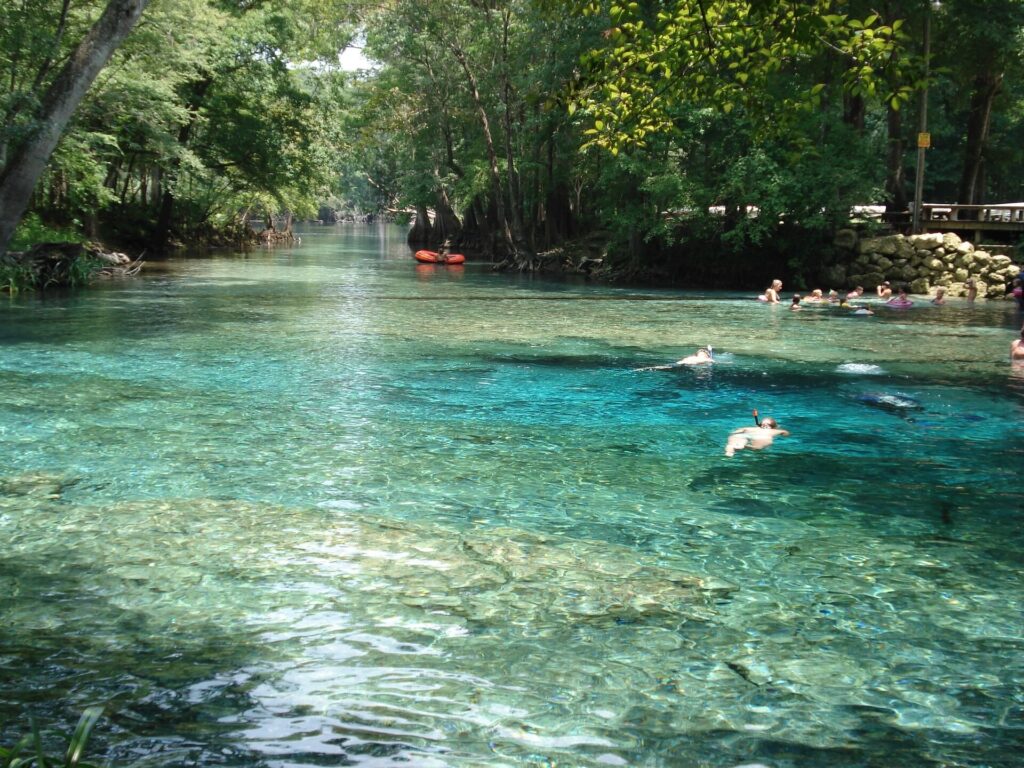
The spring basin is the better bet for snorkeling. Water there is clear enough to see straight to the sand and watch fish hold in the current. Downstream, the river stretch is where you actually feel the current do the work. Most groups spend the morning in the spring, then move to the river once the sun has warmed it a little. The closest comparison in our guides is the clearest beaches in the Florida Keys.
Cave Diving in Florida
Ginnie is a dive destination as much as a swimming hole. The terrain underwater is the reason. The Ginnie Ballroom, an amphitheater-sized chamber inside Ginnie Cavern, tops out at 50 feet deep. It’s open to any certified diver carrying a light — open-water certification is enough, no cave card required. A safety grate blocks the passage beyond it. The park’s own dive page puts the outflow there at roughly 35 million gallons of water a day.
Devil’s Eye and Devil’s Ear are a different story. Both sit inside the Devil’s Spring System, which the park’s dive page puts at nearly 80 million gallons a day combined. Both require a certified cavern or cave card before you can carry a light in. Ginnie enforces a strict no-lights rule for anyone without one, plainly and without exception. Devil’s Eye is a round opening about 20 feet across and 20 feet deep, water clear enough to look straight up and count leaves on the trees above it. Devil’s Ear is where the spring run meets the river, water pushing out with something close to fire-hydrant force. Neither opening is a place to swim in without the right training, whatever the water looks like from above.
How Deep Is Ginnie Springs?
Depth depends on the spot. The Ballroom dive tops out around 50 feet. Devil’s Eye’s opening runs about 20 feet down before it connects into cave passage. Snorkelers see a shallower version of that same clarity from the surface, no tank required. No cave training needed either. None of it is a place to explore past what’s visible without the right card, though. The interesting parts of Ginnie are for certified divers only.
Ginnie Springs Camping
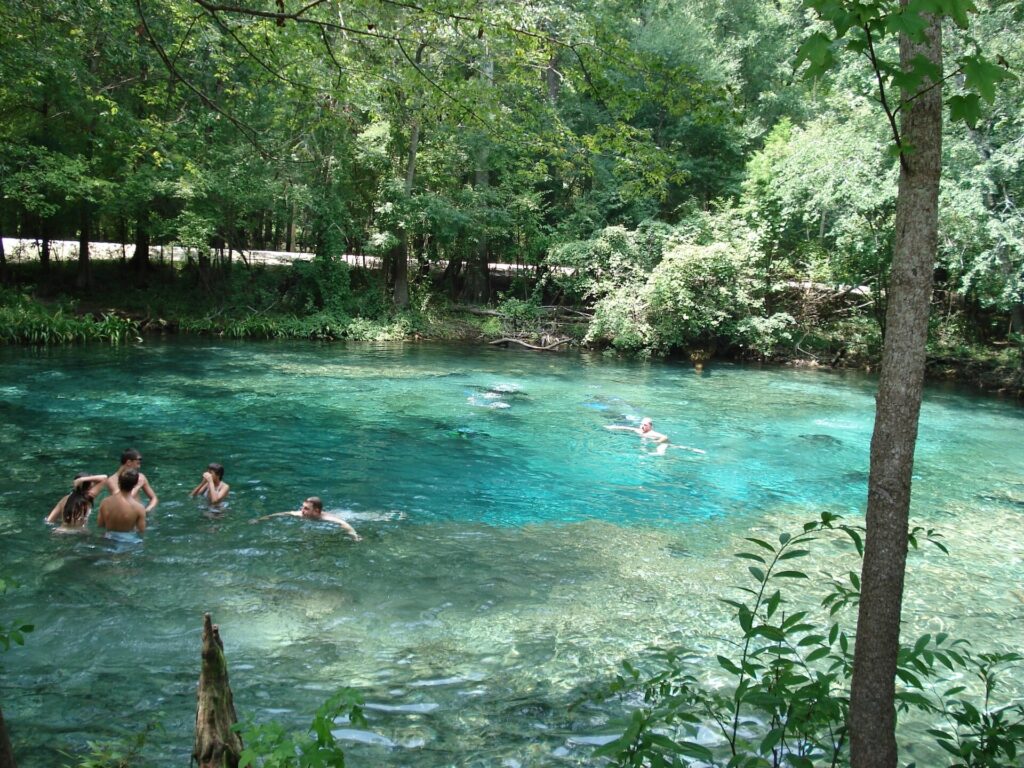
Camping spreads across roughly 200 wooded acres, some of it right on the river. Tent sites are first-come, first-served, most with a grill and picnic table, and a handful with running water nearby. Water and electric sites sit across from the park’s general store — 123 of them, per the park’s own camping page. They come with hookups but no sewer at the site itself; a dump station covers that instead. It’s a busy loop on a summer weekend, and a quiet one most other times.
Reserve a water/electric site at least 48 hours out through the park’s booking system. Expect a two-night minimum from April through September. Tent camping doesn’t need a reservation, unless you’re bringing a group of 30 or more in the off-season. Ginnie’s general store anchors that loop, the easiest place to pick up ice or firewood. Pack for the trip the way you would for any campground stay — see our camping gear checklist.
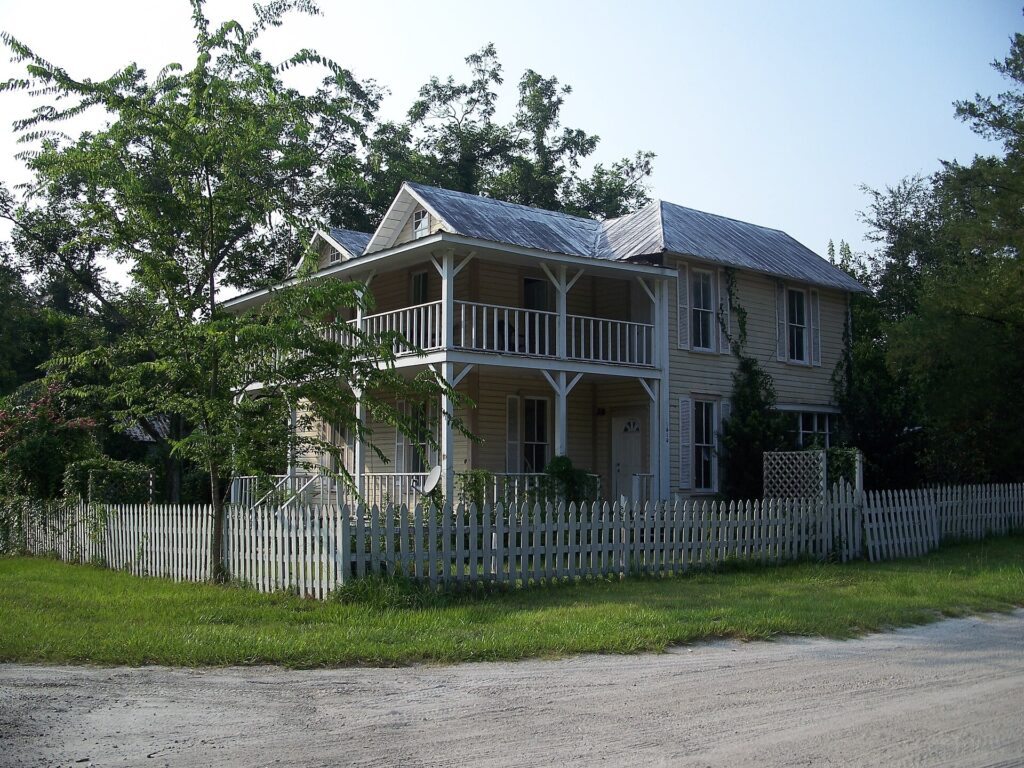
High Springs is the town Ginnie sits closest to, a few miles down a two-lane road under oak canopy. It’s small, built around a historic downtown, with more antique shops than restaurants. Worth a slow drive through on the way in or out, even if the springs are the main event. The pace is a lot slower than the springs get on a Saturday in July. This stretch of Alachua and Columbia counties sits over the same aquifer that feeds the Santa Fe and the Suwannee, which is why so many named springs cluster here. Ichetucknee Springs State Park is about 25 minutes east, a good pairing if you want two spring runs in one weekend. Our guide to the best Florida springs near Gainesville covers more of the springs in this area.
Best Time to Visit Ginnie Springs
I’d point a first visit at a weekday, ideally outside of June through August. Ginnie built its reputation partly on the diving, and partly on the crowd. Summer weekends pull a loud, packed scene, coolers and music included. That’s fine, if that’s what you’re after. It’s a different park on a Tuesday morning in October: quiet water, easy parking, a spring basin you can actually see across without someone’s tube in the shot.
Families do better outside peak summer weekends. Divers get calmer, clearer water in the cooler months, once fewer bodies have stirred up the basins. Winter cools the river enough that the 72°F spring water feels almost warm by comparison, which is part of why the diving crowd treats the off-season as the good season. The park’s own posted rules keep glass out of the water and the common areas year-round. Open containers stay limited to campsites, so even a busy weekend isn’t a free-for-all.
Prices are approximate, current as of publication, and change frequently — confirm the latest price with the retailer before buying.
Tubing FAQ
Do you need a reservation for Ginnie Springs? Not for a day visit or tent camping, except for groups of 30 or more in the off-season. A water/electric campsite needs to be booked at least 48 hours ahead, through the park’s reservation system.
Can beginners dive at Ginnie Springs? Yes, in the Ballroom. Any certified diver with a light can go, open-water certification included. Devil’s Eye and Devil’s Ear are cave and cavern territory, open only to divers who hold that specific certification.
Is Ginnie Springs good for families? On a weekday or in the off-season, yes: calm water, easy parking, a swimming area shallow enough for kids to wade. Summer weekends skew toward a louder, older crowd. Pets aren’t allowed anywhere on the property.
How far is Ginnie Springs from Ichetucknee? About 25 minutes by car. That makes a two-spring weekend an easy add, not a separate trip.
Published September 28, 2026.
Photo credits: (1) featured, A clear turquoise spring pool ringed by… — (WT-de) Mistoffeles, CC BY-SA 4.0, via Wikimedia Commons; (2) Swimmers and a red canoe in the turquoise… — (WT-de) Mistoffeles, CC BY-SA 4.0, via Wikimedia Commons; (3) Swimmers in the clear blue water at Ginnie… — (WT-de) Mistoffeles, CC BY-SA 4.0, via Wikimedia Commons; (4) Historic downtown street in High Springs… — Ebyabe, CC BY 2.5, via Wikimedia Commons.