

Some links on our site may earn us a commission at no extra cost to you. Learn more.
Salt Springs is a first-magnitude spring in Ocala National Forest. It’s built around a wide swimming basin, a small marina, and one of the biggest campgrounds anywhere in the forest. The water carries a faint mineral edge — hence the name. It holds at a constant 74°F year-round, according to the Forest Service. Salt is the pick for a multi-night stay, not a single afternoon. It’s the only spring in the forest with full RV hookups. Along with Juniper and Alexander, it’s one of the forest’s three big developed springs, and the only one built around camping rather than paddling.
I’ve spent plenty of afternoons in the springs scattered through Ocala National Forest. Salt is the one where I’ve actually pitched a tent, not just parked for a swim. It’s set up differently than Juniper or Alexander down the road. Full hookups, a marina, a boat launch. That changes the whole visit from a stop into a stay.
What are Salt Springs?
Salt Springs sits inside Ocala National Forest, about 35 miles east of Ocala off FL-19, in the small community that shares its name. The spring is what hydrologists call first-magnitude. The Forest Service puts its flow at roughly 52 million gallons a day. All of it holds at that constant 74°F, no matter the season.
The “salt” in the name is real but mild. A faint mineral edge in the water gives it away, not an ocean taste. That’s part of what sets the swimming basin here apart from Juniper or Alexander. The basin runs shallow near the edges and deeper toward the middle. It’s known for the blue crabs that work the sandy bottom — one of the few Florida springs where they turn up regularly. The water itself runs a pale, glassy blue. That’s different from the near-invisible clarity of Ginnie or Rainbow further north, and it’s the mineral content doing the work.
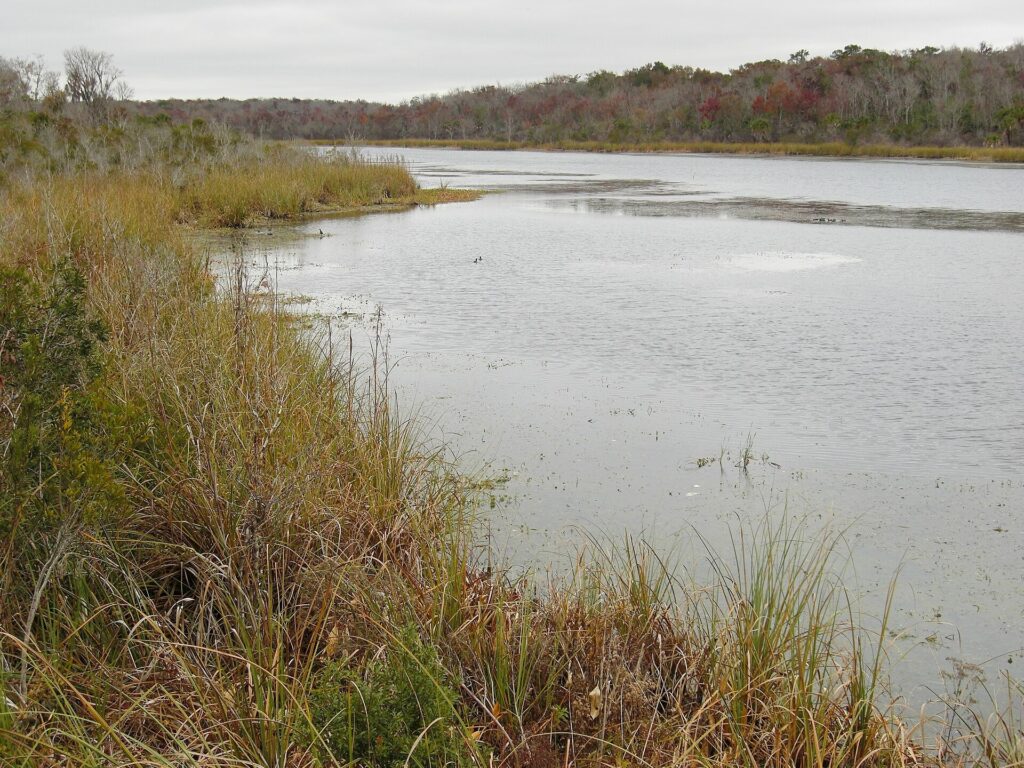
A short loop trail, under two miles, leaves the day-use area. It crosses a stretch of Big Scrub habitat to an observation platform over the marsh. Snorkeling is allowed throughout the swim area, and visibility holds up well outside of heavy rain. Bring water shoes. The bottom is sand and limestone, not the soft mud some of the blackwater rivers nearby have.
Salt Springs hours
Salt Springs runs on the same seasonal clock as the rest of Ocala National Forest’s swimming areas. Hours shift through the year. The current schedule sits on the Forest Service’s own Salt Springs page rather than staying fixed year-round. Check it before a winter trip, since gates can close earlier once daylight shortens. The day-use area has picnic tables and a small interpretive site near the parking lot. It’s worth a few minutes, even if the plan is to head straight for the water.
The forest doesn’t publish one flat day-use dollar figure for Salt Springs, the way a state park does. An annual day-use pass covers entry here along with several other Ocala-area recreation areas. The concession that runs the site posts current single-visit pricing separately. When in doubt, check the current fee on fs.usda.gov before you go.
Camping is billed apart from day use, whether you’re staying the night or just swimming for the afternoon. Pets aren’t allowed in the day-use area, so leave the dog at the campsite if you’re bringing one along. Pack in your own drinking water refills too. The bathhouse taps are the only fixed source once you’re past the gate.
Salt Springs camping reservations
The campground at Salt Springs is the largest in Ocala National Forest, and it’s the only one with full hookups. The Forest Service counts 106 standard electric sites plus 54 tent-only primitive sites. That’s enough room that a same-week reservation is realistic in the electric loop, which isn’t true at a smaller campground like Juniper’s.
Book through Recreation.gov or by phone, and plan around a 14-day stay limit within any 30-day stretch. Check Recreation.gov for current nightly rates. Neither the recreation area page nor the booking system holds one number all season. Weekends fill first in the electric loop, especially anywhere close to the bathhouse. A weekday arrival still buys the most choice of site.
| Loop | Sites | Hookups | Best for |
|---|---|---|---|
| Electric (HKUP) | 106 sites | Water & electric | RVs and trailers |
| Tent-only | 54 sites | None | Tent camping, minimal gear |
Quiet hours run 10 p.m. to 6 a.m. Two vehicles come included per site before an extra-vehicle fee kicks in. Bathhouses, flush toilets, and drinking water are on-site; cell service mostly isn’t. Plan around that before you arrive. A short stretch of the Florida National Scenic Trail runs through the campground loop, with Bear Swamp Trail branching off it — a walk that isn’t just to the bathhouse and back. There’s a basketball court and a horseshoe pit near the tent loop too. That matters more than it sounds like on a third rainy afternoon with kids who’ve already been swimming twice.
Boat ramp Lake George FL
Salt Springs Run carries the spring’s outflow west to Lake George, Florida’s second-largest lake after Okeechobee. The campground has its own unimproved boat launch at the end closest to the run. It’s a plain ramp, not the marina. Bring your own trailer, and expect a soft bottom right at the water’s edge.

For a rental, the Salt Springs Marina handles canoes on a first-come, first-served basis right at the recreation area. It’s the easier way onto the run without hauling a boat of your own. You’re on the water in a few minutes, not after a full afternoon of loading and unloading.
Fishing is the other reason boats launch here. Salt Springs Run and Lake George both hold bass and panfish. A Florida freshwater fishing license is required the moment a line goes in, even from the bank. A handful of small fish camps sit a short drive away on Lake Kerr. That’s another option if the campground’s own launch is busy, or the run feels too crowded for a quiet cast.
Outside the gate, the small community of Salt Springs carries a grocery store, a gas station, and a post office. Useful, if a forgotten cooler or a dead phone charger threatens the trip. It isn’t much. After a few nights at a forest campground with no cell service, it’s enough.

Salt Springs vs Juniper Springs
Salt and Juniper sit inside the same forest, roughly 30 minutes apart by car. They solve different problems. Salt is the swim-and-camp pick: a wide basin, a full-hookup campground, and a marina, built for a multi-night stay. Juniper is built around its run instead. The Forest Service describes it as a narrow, winding paddle through old-growth canopy, one of the more scenic short canoe trips in the state. It launches from a spring pool that’s shallow at one end and deep enough to jump into at the other.
Juniper’s campground is smaller, with no hookups. Its CCC-era Mill House gives it more history to look at while you wait on a canoe shuttle. Salt has none of that history. But it has the hookups and the boat access that Juniper doesn’t.
If the trip is about swimming and staying put, pick Salt. If it’s about a few hours on the water under trees, Juniper wins. Alexander splits the difference, with its own swimming beach and a longer paddle on Alexander Run. But its campground is smaller than Salt’s, and it skips the hookups entirely.
Planning more of the forest? Our Florida springs guide lines up the rest by region. Our camping gear checklist is worth a look before a multi-night stay at a full-hookup site like this one. Ichetucknee Springs, to the north, makes another easy stop on the same swing through north-central Florida.
Camping FAQ
Is Salt Springs a state park?
No. Salt Springs is a Forest Service recreation area inside Ocala National Forest, not a Florida state park. It’s run under a Forest Service concession agreement. That’s why fees and hours are listed on fs.usda.gov and Recreation.gov, rather than a state parks site.
Is Salt Springs salt water?
No, despite the name. The water carries a mild mineral taste, not the salinity of the ocean or a brackish estuary. It’s fresh enough at the source to drink, the same as the forest’s other springs.
How deep is Salt Springs?
The swimming basin runs shallow near the edges and drops off toward the middle. It’s deep enough for a real swim without being extreme. The recreation area doesn’t publish an exact maximum depth. Treat the deeper water the way you would any open spring, and don’t dive in blind.
Can you swim at Salt Springs?
Yes — swimming is the main draw. The basin stays open to swimmers year-round, weather and water levels permitting. Snorkeling is allowed throughout the swim area.
Does Salt Springs have alligators?
Alligators live throughout Ocala National Forest’s lakes and rivers, and Salt Springs Run is no exception. They’re rarely seen in the swimming basin itself. But treat any nearby dark water — the run, the boat launch — as gator habitat, and keep pets and kids close.
Salt Springs is one of three Ocala National Forest springs, along with Juniper Springs and Alexander Springs. The Florida springs road trip runs them in order.
Published October 1, 2026.
Photo credits: (1) featured, Wide view of open water and marsh from the… — Bryan Lindenberger, CC BY-SA 3.0, via Wikimedia Commons; (2) Marsh and tall grass along the trail near… — Jason Hollinger, CC BY 2.0, via Wikimedia Commons; (3) The navigable boat channel entering Lake… — TampAGS, for AGS Media, CC BY-SA 3.0, via Wikimedia Commons; (4) The Salt Springs Square store and gas… — DanTD, CC BY-SA 4.0, via Wikimedia Commons.