

Some links on our site may earn us a commission at no extra cost to you. Learn more.
The Tulum ruins sit on a low limestone cliff on the Yucatán coast. They’re the only major Maya site built right on the Caribbean. Admission runs 80 pesos for Mexican nationals and 265 pesos for foreign visitors, per INAH’s own fee page. The site opens at 8 am and closes at 5 pm, with last entry at 3:30. Go early, bring a hat, and budget 60 to 90 minutes for the buildings and the beach below.
I’ve made this stop more than once on trips along that coast, usually with a niece or nephew in tow. My water bottle is always empty before I’m back at the parking lot. The heat off that limestone by mid-morning is real, and there’s almost no shade past the entrance gate. I’ve learned to go first thing, or just accept the crowds that show up by nine.
Tulum Ruins Entrance Fee
INAH’s fee page lists admission at 80 pesos for Mexican nationals and residents. Foreign visitors pay 265 pesos, a little over $14 at typical exchange rates. That’s a unified ticket now. The agency’s own page notes it already folds in the park and Grupo Mundo Maya charges that used to get billed separately, so you shouldn’t be waved toward a second window once you’re through the gate.
Hours are 8 am to 5 pm every day, with last entry at 3:30 pm. There’s no online ticketing for the general public. You buy at the window, cash or card. Kids under 13 get in free with a paying adult.
| What | Cost | Notes |
|---|---|---|
| Admission — Mexican nationals | 80 pesos | Unified ticket, covers park fees |
| Admission — foreign visitors | 265 pesos (~$14) | Per INAH’s fee page |
| Parking at the site | Small cash fee | Paid at the lot, not the ticket window |
| Shuttle from the parking lot | Small optional fee | Covers about half a mile; walking is free |
| Hours | 8 am – 5 pm daily | Last entry 3:30 pm |
Jaguar Park Tulum
The ruins sit inside Parque Nacional Tulum, a federally protected strip of coast that CONANP administers alongside INAH. For a while, visitors paid a separate park charge on top of the archaeological zone ticket. That’s the “stacked fee” older guides still describe. It’s gone now. The two agencies moved to one price at one window.
From the parking lot it’s roughly a half-mile walk to the entrance, on a paved path with intermittent shade sails. A shuttle covers the same stretch for those who’d rather skip the walk in the heat. It isn’t required. Licensed guides wait near the entrance and will take you through for a negotiated fee. Plenty of first-timers skip the guide and use the numbered placards instead. Those cover the main buildings well enough to make sense of the layout on your own.
The park designation covers more than the ruins. Mangrove stands and a stretch of undeveloped coastline, both north and south of the site, fall under the same protection. That’s part of why the beach below the ruins still looks the way it does. So much of the Riviera Maya has been lined with beach clubs. This stretch hasn’t been.
Do You Need a Guide for Tulum Ruins?
No. General admission gets you the whole site on your own. A guide adds context on the buildings and the walled layout, more than the placards give you. That’s worth it if you like that kind of detail. If you’re short on time or budget, skip it. The site is small enough to walk on your own in under an hour.
Getting to Tulum from Cancun
Tulum is about 80 miles south of Cancún. The drive runs roughly 1.5 to 2 hours down Highway 307, depending on traffic through Playa del Carmen. Playa itself is closer, about 40 miles north of Tulum, usually 45 minutes to an hour by car.
ADO runs direct buses from Cancún’s downtown terminal to Tulum roughly every 30 minutes, per the company’s own booking page. One-way fares start around 268 pesos, about $14, for a trip that takes about 2 hours 40 minutes. Buses from Playa del Carmen run even more often and cover the shorter distance faster. Rental cars and private transfers cost more, but they skip a transfer at the Tulum bus terminal. That terminal sits a few miles from the ruins and needs a taxi the rest of the way.
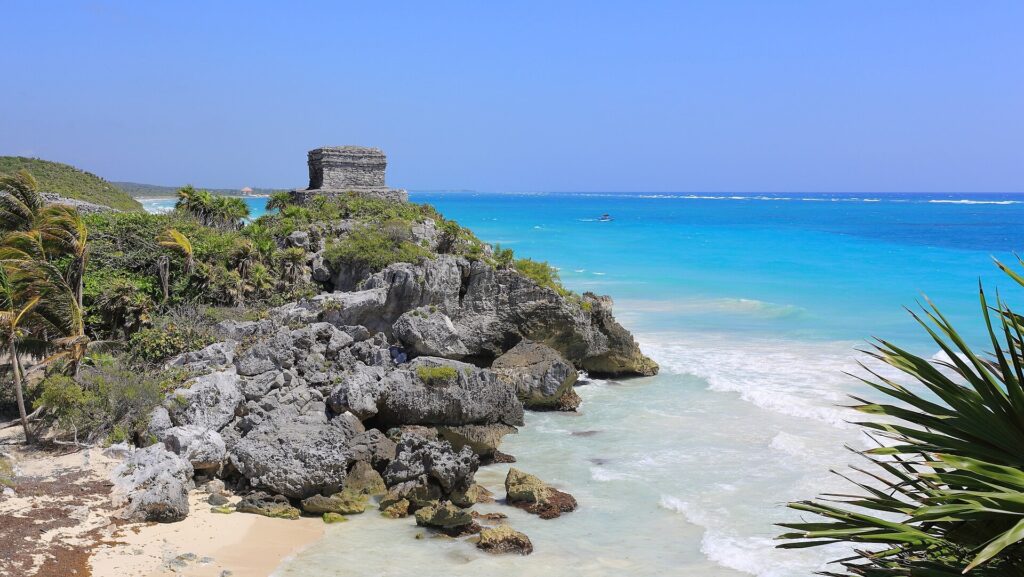
Tour vans booked out of Cancún resorts usually add extra stops along the way, so budget most of a day if you’re going that route instead of driving yourself.
Tulum Beach
Wooden stairs cut into the cliff below El Castillo lead down to a small cove of white sand. A reef offshore shields it from the open sea. The water runs shallow and calm most days. That’s why it’s the spot everyone heads for once the ruins get hot. It closes when the site does, so there’s no lingering past 5 pm.
Don’t expect a resort beach. There are no chairs, no palapas for rent, and no vendors working the sand — this stretch sits inside the protected park, not a hotel zone. Bring your own towel. Don’t count on shade once you’re down the stairs.

Iguanas are the other thing people remember. They sun themselves on the stone walls and platforms all over the site, mostly ignoring the foot traffic. It’s one of the easiest wildlife sightings anywhere on this coast. A lot of visitors pair a morning at the ruins with an afternoon at a freshwater cenote inland. That’s a common combination on this part of the Yucatán, and a good way to cool off after a dusty walk through limestone.
Can You Swim at Tulum Ruins?
Yes. The beach below El Castillo is open to swimming during site hours, and it’s the main reason to bring a swimsuit under your clothes. There are no lifeguards and no rental gear at the beach itself. Plan to bring your own towel and water shoes if you want them.

Is Tulum Ruins Worth It?
I think so, with a couple of conditions. If you’re doing one archaeological stop on a Yucatán trip and want a beach attached to it, this is the one. No other major Maya site sits on open water. Ruins and swimming in the same stop is genuinely rare.
Set expectations first, though. The buildings here are smaller than Chichén Itzá’s. You can’t climb any of them — walkways keep everyone at a set distance from the stonework. What you’re paying for is the setting more than the scale: a walled city on a cliff, iguanas underfoot, the water right there. Go early or late in the day. By mid-morning the site fills with tour groups from Cancún and Cozumel cruise passengers on shore excursions, and the shade disappears with them.
Families with strollers, or anyone unsteady on uneven footing, should know the paths are packed limestone gravel, not pavement. The stairs down to the beach are narrow, with no railing for most of the descent. Skip it on a day with a heat advisory. Skip the stairs if you’re carrying a toddler — there’s plenty to see from the top without making that climb.
Tulum Ruins Facts
A few questions come up more than any others once people start planning the stop.
How Much Does It Cost to Visit Tulum Ruins?
80 pesos for Mexican nationals and residents, 265 pesos for foreign visitors, per INAH’s fee page. That single ticket covers the archaeological zone and the park fees once charged separately. Parking and the optional shuttle from the lot are small cash add-ons.
What Time Do the Tulum Ruins Open?
8 am daily. Gates close at 5 pm, with last entry at 3:30 pm. Arriving at or near opening is the single best move for avoiding the heat and the tour-bus crowds that build through late morning.
How to Get to Tulum Ruins from Cancun?
By car it’s about 80 miles down Highway 307, roughly 1.5 to 2 hours. ADO runs direct buses from Cancún about every 30 minutes. Fares start near 268 pesos for a trip of about 2 hours 40 minutes. Tour vans and private transfers cover the same route for more money and less hassle.
A day like this packs well into a carry-on. Our beach vacation packing list covers what actually earns space for a Yucatán stop. Weighing a cruise excursion to Tulum out of Cozumel or Costa Maya instead? Our cruise packing list covers what to carry off the ship for a shore day like this one. Flying home through a different US airport than you flew out of? It’s worth checking TSA PreCheck vs. Global Entry vs. CLEAR before you go — re-entry lines are where a tight connection actually falls apart.
Prices are approximate, current as of publication, and change frequently — confirm the latest price with the retailer before buying.
Published October 4, 2026.
Photo credits: (1) featured, El Castillo, the largest structure at the… — Bjørn Christian Tørrissen, CC BY-SA 3.0, via Wikimedia Commons; (2) The Temple of the Wind God, a small stone… — Martin Falbisoner, CC BY-SA 4.0, via Wikimedia Commons; (3) An iguana on the stone ruins at the Tulum… — Adam Jones from Kelowna, BC, Canada, CC BY-SA 2.0, via Wikimedia Commons; (4) The beach below the Tulum ruins, with the… — Bernard DUPONT, CC BY-SA 2.0, via Wikimedia Commons.