

Some links on our site may earn us a commission at no extra cost to you. Learn more.
The best time to visit the Smoky Mountains is late September through the first two weeks of October. You get comfortable weather at every elevation, plus the first color showing on the high ridges. Roads are still fully open, and the crowds of late October haven’t arrived yet. If wildflowers or synchronous fireflies are the actual point of your trip, the answer changes. We cover both below.
I’ve come back to these mountains in spring, summer, and fall, and I’ve built a different kind of trip around each one. Spring means wildflowers and quiet overlooks for me, plus mud season and a few closed high-elevation roads. Summer means green ridgelines and warm creek water, and I’ve waited out a full Cades Cove backup more than once by mid-morning. Fall is the season I plan around most. It’s worth it, if you time it around the crowds instead of just the calendar.
None of those three seasons is wrong. It just depends on whether you’re chasing color, blooms, or a hike that starts before dawn. What follows is the month-by-month breakdown we actually use to plan our own trips back.
When Is the Best Time to Visit the Smoky Mountains?
There isn’t one right month, because “best” depends on what you’re actually after. Fall color, spring wildflowers, and firefly season each peak at a different point on the calendar. None of them line up with the park’s quietest weeks. Here’s how the seasons stack up, using the National Park Service’s own weather and elevation figures.
| Season (Months) | Low Elevation Avg High/Low | High Elevation (Kuwohi) Avg High/Low | What’s Open | Crowds | Our Verdict |
|---|---|---|---|---|---|
| Winter (Dec–Feb) | 51°F / 28°F | 35°F / 19°F | Kuwohi Road closed; most low-elevation trails open | Lightest of the year | Good for solitude, not for the high country |
| Spring (Mar–May) | 61–79°F / 34–50°F | 39–57°F / 24–43°F | Wildflowers building; March snow still possible | Building toward summer | Best for wildflowers and empty overlooks |
| Summer (Jun–Aug) | 86–88°F / 58–60°F | 63–65°F / 49–53°F | Everything open; Cades Cove closed to cars on Wednesdays | Heaviest of the year, especially July | Green and warm, crowded by mid-morning |
| Fall (Sep–Nov) | 73–83°F / 43–55°F | 42–60°F / 28–47°F | Kuwohi Road open into late November | Heaviest of the year in October | Best overall mix, if you avoid October weekends |
Low elevation means Gatlinburg and the valley floor. High elevation means Newfound Gap and Kuwohi, roughly a mile higher up. That gap in temperature is the single biggest thing to plan a Smokies trip around, whatever month you pick.
Smoky Mountains Weather by Month
Temperatures can swing 10 to 20 degrees between the valley floor and the high ridges, in any season, the park’s weather page shows. A warm, clear morning in Gatlinburg can mean a cold, foggy one at Newfound Gap an hour later — our best time to visit Gatlinburg guide breaks down how the town’s calendar differs from the park’s. Dress in layers if you’re driving up, even in summer.
Spring is the least predictable stretch of the year. March can still bring snow at elevation, and April averages more than 4 inches of rain. Summer brings heat, real humidity, and afternoon thunderstorms that build most days. Plan hikes for the morning.
Fall is the driest season here, with the first frost usually reaching the valleys by late September. Winter brings snow one to five times most years down low. Higher up, storms can drop up to two feet at a time, most likely in January and February.
Annual rainfall runs from around 55 inches in the lowlands to 85 inches on the highest peaks. That range alone makes this one of the wettest corners of the eastern United States. It’s wetter than most of the coast. Pack for rain no matter which month you land on.
That rain and elevation combination is also where the range gets its name. The bluish haze over the ridgelines on a humid morning is real moisture rising off the forest, not distant smoke. It shows up in some form most days of the year. Fewer humid days means a clearer haze, which is one more reason fall photographs so well here.
Best Time to Visit Smoky Mountains for Fall Colors
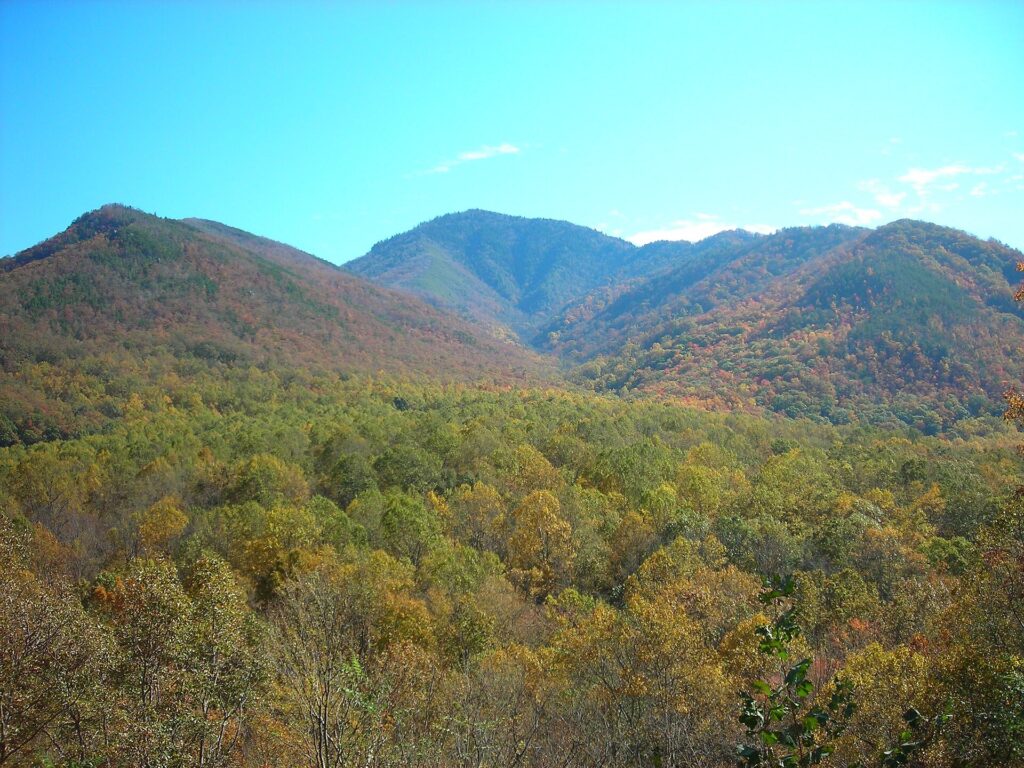
Color moves down the mountain over several weeks, not all at once. It starts above roughly 4,000 feet, on ridges like Newfound Gap and Kuwohi. From there it works down to the valley floor by late October or the first days of November.
October is the single busiest month in the park. The two or three weekends around peak color are the worst of it. A weekday morning in early October gives you real color without a parking lot’s worth of company at every overlook.
A parking tag is required at every lot and trailhead in the park, not only during leaf season. The park’s fee page puts it at $5 a day, $15 a week, or $40 a year. Keep it visible on the dash; rangers do check.
When Do the Wildflowers Bloom in the Smoky Mountains?
Peak bloom at the lower elevations usually lands in mid-to-late April, the park’s wildflower page shows. The high country follows a few weeks behind. More plant species grow here than in any other national park. That’s part of why people call this the wildflower national park.
The park runs a Spring Wildflower Pilgrimage every year, a full week of guided walks built entirely around this bloom. Outside pilgrimage week, the trails through these same woods are some of the quietest you’ll find all year, mud aside.

When Is the Best Time to See Fireflies in the Smoky Mountains?
Synchronous fireflies put on a show almost nobody sees anywhere else: thousands of them blinking in unison. It lasts about two weeks, somewhere between late May and mid-June. Exact timing shifts year to year, since the park uses soil temperature, not a fixed date, to predict it.
Access to Elkmont during that peak window runs through a lottery on Recreation.gov. The park’s own firefly page lists an application window in late April, notification by early May, and an eight-day viewing period in late May. A $1 application fee applies to everyone who enters; winners then pay $29 for a vehicle reservation.
Outside that eight-day window, Elkmont is open like any other campground. The fireflies are still around, just in smaller numbers. If the lottery doesn’t come through, go a week or two on either side of the announced dates instead. You’ll still get fireflies, just not the full synchronized show.

Great Smoky Mountains Road Closures
Kuwohi Road closes each winter, typically from December 1 through March 31, the park’s road status shows. Severe weather can add extra closed days on either end. Our Kuwohi guide covers what’s open the rest of the year and what the hike up looks like.
Cades Cove Loop Road closes to vehicles on Wednesdays from May 6 through September 30, per the park’s current schedule. That leaves the road to walkers and cyclists for the day. We break down the full schedule in our Cades Cove guide.
Roaring Fork Motor Nature Trail and the gravel road out to Balsam Mountain both close for winter too. Both reopen once the weather turns in spring. Newfound Gap Road itself can also close for a day or two at a time in snow or ice. That’s separate from the regular winter closure higher up.

Least Crowded Time to Visit Smoky Mountains
July and the back half of October are the two heaviest stretches in the park, by a wide margin. If crowds bother you more than heat or bare trees, plan your trip around both of those windows.
January and February sit at the other end of it: cold at elevation, with no leaves or wildflowers to draw a crowd. What you get instead is empty pullouts and short waits almost everywhere, Cades Cove included. Weekday mornings, in any month, beat weekend afternoons by a wide margin too.
Sugarlands Visitor Center and the Newfound Gap overlook fill first on any busy day, usually by mid-morning. Cades Cove backs up behind the loop’s single one-way lane once traffic builds. A stop for wildlife can cost an hour or more, so an early start there matters more than almost anywhere else in the park.
Whatever month you land on, our Smoky Mountains itinerary can help you build the days around it. Our full trip-planning guide covers logistics for every season, not just timing.
What Is the Best Time to Visit the Smoky Mountains?
A few quick answers to the questions we hear most about timing a Smokies trip.
What Is the Best Month to Visit the Smoky Mountains?
For most people, that’s late September or early October. You get mild weather, the first color at elevation, and lighter crowds than late October brings. If wildflowers matter more to you than fall color, make it April instead.
Cheapest Time to Visit the Smoky Mountains
Late January and February tend to be the slowest stretch for lodging in the gateway towns. It’s cold, and there’s little color or bloom to draw visitors. Cabin and hotel rates in Gatlinburg and Pigeon Forge typically follow that lull.
When Is the Best Time to Visit the Smoky Mountains in the Fall?
Early-to-mid October usually gives you color starting at elevation without the weekend crowds that build later in the month. The last two weekends of October are consistently the busiest stretch of the entire year in the park.
What Is the Rainiest Month in the Smoky Mountains?
The park doesn’t publish one single wettest month. Spring and summer bring the most rain overall, with afternoon thunderstorms common through summer. Fall is the driest season by a clear margin, which is part of why it draws the biggest crowds.
Prices are approximate, current as of publication, and change frequently — confirm the latest price with the retailer before buying.
Published September 26, 2026.
Photo credits: (1) featured, Fog over fall-colored mountain ridges along… — National Park Service, U.S. Government work, public domain, via Wikimedia Commons; (2) Mount Le Conte in the Great Smoky Mountains… — Scott Basford, CC BY-SA 3.0, via Wikimedia Commons; (3) White trillium wildflower blooming on the… — Jim Sorbie, CC BY 2.0, via Wikimedia Commons; (4) Synchronous fireflies (Photinus carolinus)… — Niemand für Polyphemus, CC BY 2.0, via Wikimedia Commons; (5) Newfound Gap Road covered in snow in the… — National Park Service, U.S. Government work, public domain, via Wikimedia Commons.