

Some links on our site may earn us a commission at no extra cost to you. Learn more.
A Yellowstone itinerary works best over three full days. Give one day to the geyser basins. Give a second day to the canyon and wildlife-heavy Lamar Valley, and a third to Mammoth Hot Springs on the way out. The park’s entrance fee is $35 per vehicle for seven days, per the National Park Service. That single fee covers everyone in your car for the whole trip. Old Faithful is the anchor for day one. It erupts every 50 to 127 minutes and rarely makes visitors wait long, per the National Park Service.
I’ve made the Chicago-to-California drive and plenty of Western road trips since. So I plan big parks the same way every time. Pick three anchor stops, then build the driving around them, not the other way around. In Yellowstone, that means the geyser basins one day, the canyon and wildlife the next, and Mammoth on the way out. The park is simply too spread out to wing it.
Yellowstone Itinerary 3 Days
| Detail | What to know |
|---|---|
| Entrance fee | $35 per vehicle (7 days), $20 per person on foot or bike, per the National Park Service |
| Annual pass | $70, valid through the month of purchase for 12 months, per the National Park Service |
| Reservations | None for park entry; the park is open 24 hours a day, per the National Park Service |
| Visitor centers | Old Faithful and Canyon open April 17-October 31; several others open mid-May, per the National Park Service |
| South entrance note | Routes through Grand Teton, which charges its own separate entrance fee, per the National Park Service |
| Best season | Late May through September for full road access; early June still has snowpack at higher elevations |
The arithmetic: for two adults sharing one vehicle, the $35 entrance fee works out to $17.50 per person for a single trip. An annual pass costs $70 and breaks exactly even after your second visit within 12 months, because $35 x 2 equals $70. So the annual pass only pulls ahead once you clear a third visit in that window. For most people planning one Yellowstone trip this year, the standard vehicle pass is the better deal.
| Day | Focus | Key stops | Approx. drive time |
|---|---|---|---|
| Day 1 | Geyser basins | Old Faithful, Upper Geyser Basin, Grand Prismatic Spring | Short hops, mostly walking |
| Day 2 | Canyon and wildlife | Grand Canyon of the Yellowstone, Artist Point, Lamar Valley | 2-3 hours round trip from Canyon Village |
| Day 3 | Mammoth and departure | Mammoth Hot Springs terraces, North or West Entrance | 1-1.5 hours from Canyon Village |
Yellowstone Entrance Fee
The park’s own fee is simple: $35 per vehicle for seven days, per the National Park Service. Gas, groceries and lodging outside the park are your real costs. Yellowstone itself charges nothing beyond entry for driving the roads and viewing the major sites. Two adults splitting a rental car and gas will spend far more on fuel than on the entrance fee. So budget for distance, not admission. Distances between the geyser basins, the canyon and Mammoth run 20 to 50 miles each, and Yellowstone’s roads rarely allow speeds over 45 mph.

Yellowstone Itinerary From West Entrance
Yellowstone has five entrances. The West Entrance near West Yellowstone, Montana and the North Entrance near Gardiner, Montana see the heaviest traffic of the five, per the National Park Service. The South Entrance is scenic, but it also runs through Grand Teton National Park, so it charges a separate fee. So plan your route around West or North if you’re flying into Bozeman. Use the South Entrance instead if you’re already combining the trip with Grand Teton, because it saves a separate drive later. The East Entrance from Cody, Wyoming sees far less traffic. The Northeast Entrance near Cooke City does too, but both add hours to reach the geyser basins.
Yellowstone Old Faithful Itinerary
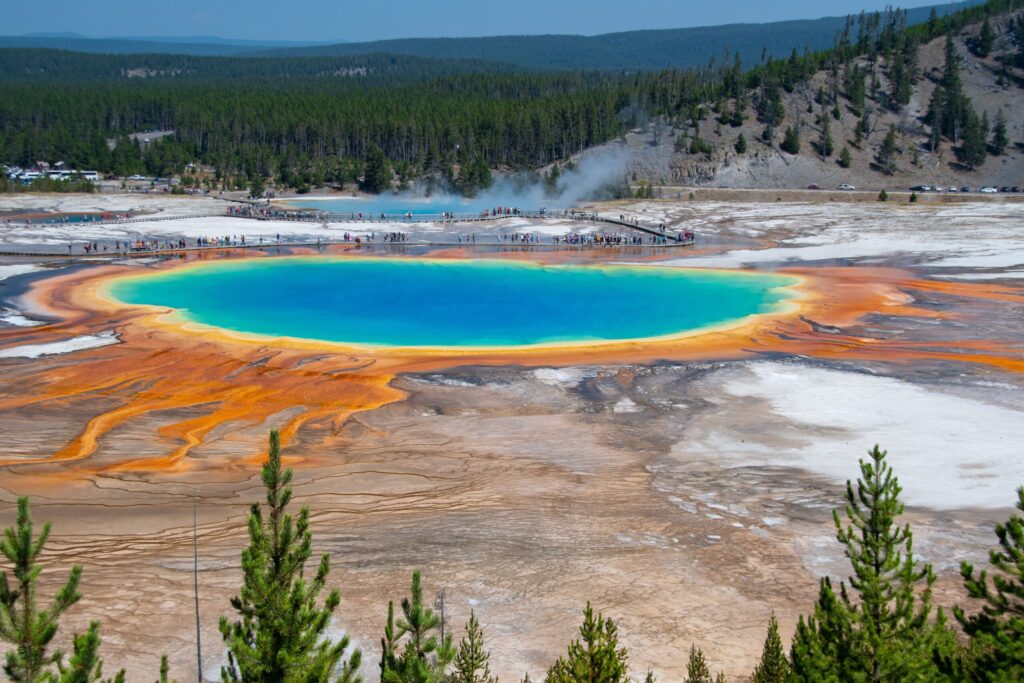
Old Faithful anchors the Upper Geyser Basin. It erupts every 50 to 127 minutes, averaging about 90 minutes apart, per the National Park Service. Each eruption reaches 106 to 184 feet high. Plan to arrive, check the posted prediction, and walk the boardwalk loop while you wait. From there, Grand Prismatic Spring is a short drive south at Midway Geyser Basin. It’s Yellowstone’s largest hot spring, 200 to 330 feet across and more than 121 feet deep, per the National Park Service. Together, these two stops fill a full day without much driving, since both sit along the same stretch of road. So plan two to three hours total at the geyser basins, plus time for lunch back near Old Faithful.

Yellowstone Lamar Valley Itinerary
The Grand Canyon of the Yellowstone is the second anchor. Artist Point gives the classic view of the Lower Falls, and it’s also an easy short walk from the parking area. From Canyon Village, Lamar Valley is a scenic 2 to 3 hour round trip. Open grassland lines the valley, where bison and wolves are commonly seen. Yellowstone counted roughly 5,400 bison as of August 2024 and at least 108 wolves as of January 2025, per the National Park Service. So sightings are common, but never guaranteed, because both species move across a huge landscape. Go early morning or near dusk for the best odds, because wildlife tends to move into tree cover during the heat of the day. Bring binoculars instead of expecting close-range views, because most wolf sightings happen at a real distance across open valley floor.
Mammoth Hot Springs Itinerary
Mammoth Hot Springs sits near the North Entrance. It looks nothing like the geyser basins you saw on day one. Its travertine terraces build up in white and orange layers instead of erupting. First, walk the boardwalk loop in the morning, before tour buses arrive. Then use Mammoth as your exit point if you’re heading toward Bozeman or continuing north into Montana.
Yellowstone Lodging Reservations
Book in-park lodging and campgrounds months ahead. Rooms inside the park sell out well before summer, per the National Park Service’s own booking guidance. Also reserve a rental car early if you’re flying into Bozeman or Jackson. Summer demand regularly outstrips supply at smaller regional airports. You do not need to book park entry itself. There’s no timed-entry reservation system at Yellowstone as of this writing, unlike some other major parks. If your dates are flexible, shoulder-season travel in June or September also makes last-minute lodging easier to find.
Yellowstone Itinerary for First Timers
Skip trying to drive the entire Grand Loop Road in one day. The park’s size and 25 to 45 mph road speeds make that exhausting rather than fun. Also skip midday visits to Old Faithful and Grand Prismatic in July and August, since parking lots fill fastest during those peak hours. Finally, skip off-trail shortcuts near any hydrothermal feature. The ground crust can be thin and dangerously hot beneath a normal-looking surface, and staying on marked boardwalks avoids that risk entirely.
Best Time to Visit Yellowstone
Late May through September gives you full access to the Grand Loop Road. Every major stop opens in that window, per the National Park Service’s seasonal road schedule. June still carries snowpack at higher elevations, so pack layers even in summer. September thins the crowds while keeping most roads open, which makes it a strong pick if your schedule allows a shoulder-season trip instead of peak July. Browse more Mountain West destination guides if you’re planning other stops nearby. If the trip heads through Colorado, Browns Canyon vs Royal Gorge compares the two best-known rafting runs in the state.
Frequently asked questions about a Yellowstone itinerary
Is 3 days enough for Yellowstone?
Three days is enough to cover the park’s three biggest anchors: the geyser basins, the canyon with Lamar Valley wildlife, and Mammoth Hot Springs, without feeling rushed at any single stop. Add a fourth day instead if you also want to explore Yellowstone Lake or hike farther into the backcountry, because three days covers the highlights but not everything.
Do you need a reservation to enter Yellowstone?
No, Yellowstone does not currently require a timed-entry reservation; you pay the standard entrance fee at the gate or show a valid pass instead.
Which Yellowstone entrance is closest to Old Faithful?
The West Entrance near West Yellowstone, Montana sits closest to Old Faithful and the geyser basins. It’s the most direct starting point for a day-one itinerary built around them.
Is there a pass for Yellowstone and Grand Teton?
There is no combined pass; the two parks charge separate entrance fees, per the National Park Service, even though the South Entrance road physically passes through Grand Teton on the way in. So budget for both fees if your route runs through Grand Teton, because one pass does not cover the other park.
Prices are approximate, current as of publication, and change frequently — confirm the latest price with the park, operator or provider before you go.
Updated September 23, 2026.