

Some links on our site may earn us a commission at no extra cost to you. Learn more.
Mount LeConte is the third-highest peak in Great Smoky Mountains National Park. It’s also the only summit here with a lodge, a llama supply train, and a real fan base. Five trails reach the 6,593-foot top, from a 10-mile round trip up to just over 16. Every one of them ends at the same small cluster of cabins, a backcountry shelter, and two overlooks worth the climb. There’s no road up. However you go, you’re walking the whole way.
I’ve hiked Alum Cave to the top more than once. It’s the one climb in this park I tell every strong hiker to put on the list. It’s steep in the last mile and genuinely cold at the summit, even in July. Bring more layers than the trailhead temperature suggests. The top of the mountain runs its own weather.
Alum Cave Trail
Alum Cave is the shortest way up: a 10-mile round trip that starts on Newfound Gap Road. Arch Rock comes first, a natural stone archway the trail actually passes through, with steps carved into the rock. Alum Cave Bluffs follows at 2.3 miles. It’s a curved, 80-foot overhang that miners once worked for alum, and it’s a good turnaround point for a shorter day hike.
The bluffs alone are worth the trip if you’re not up for the full climb. They stay shaded even on a hot afternoon. The overhang is big enough that a crowd can spread out along it without feeling packed in.

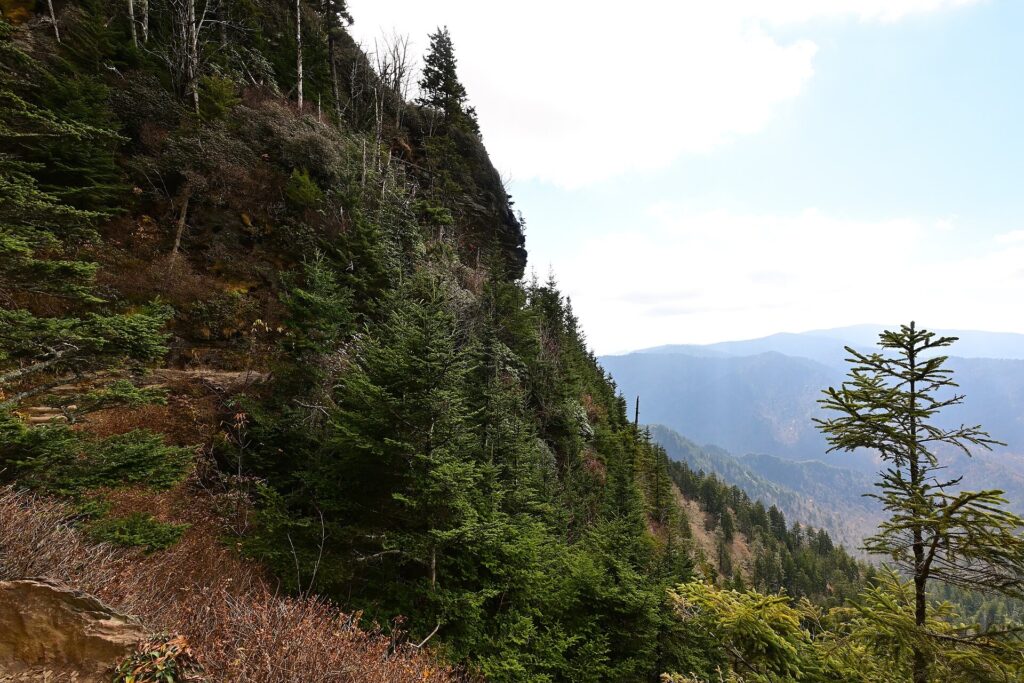
Past the bluffs, the trail climbs another three miles into spruce-fir forest. The temperature and wind both pick up noticeably the higher you get. Arrive early. The trailhead lot fills before 8 a.m. on any clear weekend, and the park’s own guidance is blunt about it: expect extreme crowding, and consider a shuttle. I’ve shown up closer to 9 a.m. more than once and had to turn around. Go before sunrise, or plan on parking along the road shoulder and walking in.
How Long Does It Take to Hike Mount LeConte?
Every route to the summit is a full day’s hike, and none of them is flat. Alum Cave is the shortest at 5.0 miles one way. Rainbow Falls and Trillium Gap both run 6.7 miles one way. Bullhead is 6.9. The Boulevard Trail is the longest at 8.1 miles one way, and it starts at Newfound Gap rather than at the base of the mountain. Those figures come from the lodge’s own trail list, since it measures all five routes against the same endpoint.
Every one of them climbs well over 2,000 feet from trailhead to summit. So the mileage difference matters less than it sounds. A shorter trail packed into fewer miles isn’t automatically easier. Alum Cave is short and steep. The Boulevard is long but more gradual, since it starts already high up at Newfound Gap.
| Trail | One way | Round trip | What sets it apart |
|---|---|---|---|
| Alum Cave | 5.0 mi | 10.0 mi | Shortest; passes Arch Rock and Alum Cave Bluffs |
| Rainbow Falls | 6.7 mi | 13.4 mi | Passes Rainbow Falls itself, roughly halfway up |
| Trillium Gap | 6.7 mi | 13.4 mi | The llama supply route, Monday/Wednesday/Friday |
| Bullhead | 6.9 mi | 13.8 mi | Quieter than Rainbow Falls, similar length |
| Boulevard | 8.1 mi | 16.2 mi | Starts at Newfound Gap, follows the Appalachian Trail first |
If you only have time for one, Alum Cave is the obvious pick. It’s the shortest, has the most scenery per mile, and it’s the trail I know best myself. Trillium Gap is worth knowing about even if you don’t hike it. It’s the trail the lodge’s llama train uses three mornings a week to haul up food and propane.
Cliff Tops
Cliff Tops is the sunset overlook, a short walk from the lodge on a spur trail. It’s the reason most overnight guests time their hike to arrive with daylight to spare. The view opens west over ridgeline after ridgeline. In winter those ridges are often dusted with snow while the valley floor is still bare.

It gets crowded at golden hour in fall, when lodge guests and late-descending day hikers both end up there at once. Bring a headlamp for the walk back. Full dark comes fast at that elevation. There isn’t much of a railing or a flat platform, just rock, so watch your footing if you’re moving around for a better photo.
Myrtle Point
Myrtle Point is the sunrise counterpart to Cliff Tops. It’s a rockier outcrop a bit farther from the lodge, on the opposite side. It faces east, which is why lodge guests set an alarm for it, layering up in the dark to catch first light on the ridgelines below.
It’s colder and windier out there than Cliff Tops, with less to block the wind. A real jacket matters, even in summer. Most guests do both overlooks in a single overnight: sunset at Cliff Tops, then sunrise at Myrtle Point the next morning. Day hikers usually skip Myrtle Point. Starting in the dark just to catch first light is a lot to ask on top of the climb itself, so most save that sunrise trip for an overnight stay.
LeConte Lodge
LeConte Lodge is open late March through mid-November, according to the lodge’s own site. It’s reachable only on foot — no road, no ATV, no helicopter drop for regular guests. Food and propane go up by llama train on the Trillium Gap Trail, three mornings a week. Guests carry themselves the rest of the way, on whichever of the five trails they choose.
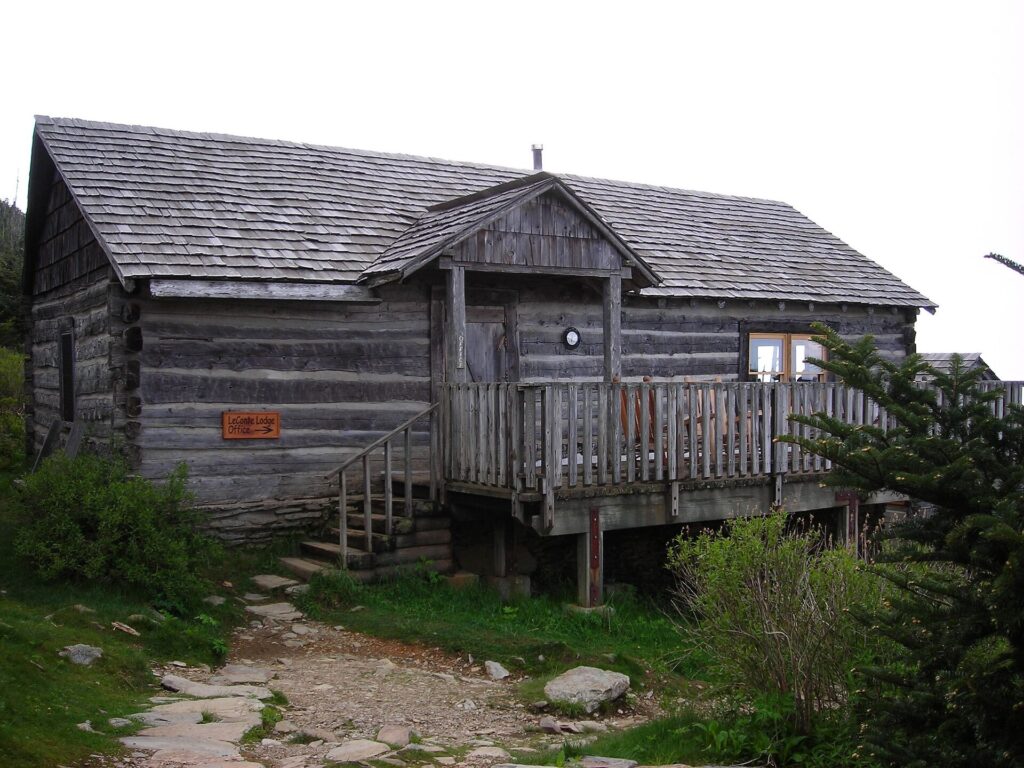
Rooms run on the American Plan, meals included. The lodge’s 2026 rate sheet lists $195 per adult per night and $106 per child aged 4 to 12; guests 3 and under stay free. Larger groups can book a full two- or three-bedroom lodge instead of an individual cabin, priced separately and still on the same meals-included plan.
Reservations for the current season typically sell out, and the lodge’s advance waitlist fills too. The realistic way in, most years, is to call right when phone booking opens for the following season. Or watch for a short-notice cancellation — those inside 30 days of arrival don’t go through the waitlist at all, so they’re first-come to whoever calls.
It’s not for anyone who wants an easy weekend. There’s no electricity in the guest cabins and no showers, and dinner is served family style at a set time. What you get instead is Cliff Tops at sunset and Myrtle Point at sunrise, without hiking either trail twice in one day, plus a hot meal you didn’t have to carry up yourself.
Mount LeConte Shelter
If the lodge is full, or not in the budget, there’s a backcountry shelter near the summit for hikers with a permit. Like every backcountry site in the park, it requires an advance reservation through Recreation.gov, not a walk-up permit at a visitor center.
The park’s current backcountry camping fee is $8 per person per night, plus a one-time $6 permit fee that isn’t refunded if your plans change. Bring your own food and water treatment, and a way to hang food away from bears. The shelter has bunks and a chain-link fence across the open side, and nothing else.
It’s first-come within your reserved date, not assigned seating, so don’t count on a bottom bunk. It’s a genuinely different trip from the lodge next door: cold, basic, and worth doing once for exactly that reason.
Is Mount LeConte a Hard Hike?
Short answer: yes, on every route. You’re gaining well over 2,000 feet no matter which trail you pick. It’s a manageable day for a fit, regular hiker, and a genuinely hard one for anyone who doesn’t hike much.
How long does it take to hike Mount LeConte? Most hikers budget a full day for any of the five routes. Alum Cave, at 10 miles round trip, is the shortest and generally the fastest.
How many trails lead to the top of Mount LeConte? Five: Alum Cave, Rainbow Falls, Trillium Gap, Bullhead, and the Boulevard Trail from Newfound Gap.
Can you drive to the top of Mount LeConte? No. There’s no road to the summit. The only ways up are the five hiking trails, or, for lodge guests, having your gear carried up by the llama train while you hike in yourself.
Is LeConte Lodge worth it? If you want sunset and sunrise from the summit without a second hike, yes. If you want a comfortable weekend with a shower, no — pack for a backcountry stay that happens to include dinner.
How Do You Get to LeConte Lodge?
On foot, on one of the five trails above. That’s the only way, for lodge guests and day hikers alike. Whichever trail you choose, you’ll need a parking tag for the trailhead lot: $5 for a day, $15 for a week, or $40 for the year. It’s the same tag that covers every parking area in the park.
Pack layers regardless of the season. Our guide to what to pack for the Smoky Mountains covers what actually earns a spot in the bag for a summit day like this one. For the rest of your trip planning, our Smoky Mountains trip-planning hub and our roundup of the best hiking trails in the Smokies both cover where Mount LeConte fits against the park’s other big hikes.
Prices are approximate, current as of publication, and change frequently — confirm the latest price with the retailer before buying.
Published September 27, 2026.
Photo credits: (1) featured, Panoramic view of Mount LeConte rising… — No machine-readable author provided. Blinutne assumed (based on copyright claims, CC BY-SA 3.0, via Wikimedia Commons; (2) The trailhead for the Alum Cave Trail on… — Blinutne, CC BY-SA 3.0, via Wikimedia Commons; (3) A mountain vista along the upper Alum Cave… — Andrew Heneen, CC BY 4.0, via Wikimedia Commons; (4) The office cabin of LeConte Lodge near the… — Wikimedia Commons contributor, CC BY-SA 3.0, via Wikimedia Commons.