

Some links on our site may earn us a commission at no extra cost to you. Learn more.
The best Glacier National Park itinerary for four days splits the park by area. Take West Glacier and Lake McDonald first, then Going-to-the-Sun Road across the middle, then Many Glacier, then Two Medicine. Sleep on the west side the first night and the east side for the last two, so the road crossing is your move and not a detour.
I plan a mountain park the way I plan a farm chore list: the job that cannot move goes first. We have done enough big national park trips with nieces and nephews along to know the day that works has a bail-out built in. Usually that is a flat walk or a lakeshore with a picnic table. In Glacier the job that cannot move is Logan Pass, so I would give it a clear morning and keep the other days loose.
How many days do you need in Glacier National Park?
Four days covers all four main areas without a sprint. Three works if you drop Two Medicine. With two days you are choosing between the west side and the east side, and the park is wide enough that you will feel the choice.
| Day | Area | Stops | Distance and time |
|---|---|---|---|
| 1 | West Glacier, Apgar, Lake McDonald | Apgar shoreline, Lake McDonald, Trail of the Cedars, Avalanche Lake | Apgar Visitor Center is about two miles north of the West Entrance; Avalanche Lake is about five miles round trip |
| 2 | Going-to-the-Sun Road | Logan Pass, Hidden Lake Overlook, then down the east side | About 50 miles end to end, 3 to 8 hours with stops; Hidden Lake Overlook is 1.3 miles one way |
| 3 | Many Glacier | Hotel shoreline, Grinnell Lake | 20 miles and 40 minutes from St. Mary; the Grinnell Lake hike is 3.4 miles, or 1.1 with the boat |
| 4 | Two Medicine | Running Eagle Falls, Aster Falls, the lakeshore | 34 miles and 1 hour from St. Mary; road work, see the day 4 section |
How do you get to Glacier National Park?
Fly into Glacier Park International Airport (FCA) in Kalispell, rent a car and drive to the West Glacier side. The airport lists several major airlines on its site. That puts you at the west end of the road, which is where this plan starts.
The other option is the train. Amtrak’s Empire Builder runs between Chicago and Seattle or Portland with a daily departure, and it stops at West Glacier and Essex. A train gets you to the park’s edge. Many Glacier and Two Medicine sit on the east side, off the shuttle routes, so you still want a car or a tour for days three and four.
Glacier National Park entrance fee
A private vehicle pays $35.00 at the gate, and the pass is good for seven days, per the park’s fee page. A motorcycle is $30.00. One person on foot or a bicycle pays $20.00. From November 1 to April 30 those drop to $25.00, $20.00 and $15.00.
Each non-US resident aged 16 and older pays a $100 nonresident fee on top, unless they arrive with an Annual or America the Beautiful Pass. A seven-day pass covers this plan with room to spare.
Lake McDonald
Start day one at the west end, where Apgar sits at the foot of Lake McDonald. The Apgar Visitor Center is at the four-way stop where Camas Road meets Going-to-the-Sun Road, about two miles north of the West Entrance. Stop there to ask about trail and road status.

Walk the shoreline early, while the water is flat. Stay out of it. The lake is colder than it looks, and sudden immersion in water below 80 degrees Fahrenheit can trigger the mammalian diving reflex. That is a bad surprise even for strong swimmers.
In the afternoon, drive up to Avalanche Creek for Trail of the Cedars. It is a 0.9-mile loop with 83 feet of climbing, on a boardwalk that is wheelchair accessible. The first half mile of the Avalanche Lake trail is that same cedar walk. After it the path gets steeper and rockier, and the lake is about five miles round trip, 3 to 6 hours.
Lots at Avalanche Creek and Logan Pass begin filling before sunrise, and a full lot stays congested all day. If it is full, drive on and take the Apgar lakeshore again. That is the bail-out built into day one.
Going-to-the-Sun Road
The road runs about 50 miles between the West Entrance and the St. Mary Entrance. Plan 3 to 8 hours, depending on how often you stop. Logan Pass, the high point, sits at 6,646 feet. Speed limits are 45 miles per hour in the lower sections and 25 in the alpine stretch.
Vehicles must not exceed 21 feet long, 8 feet wide or 10 feet tall between Avalanche Creek and Rising Sun. Leave the camper van and the trailer at the campground. Plan day two as the crossing: go early, do Logan Pass in the morning, and sleep on the east side.
Glacier National Park road conditions
The park’s road and access page says the entire road does not usually open until late June at the earliest. It also says the alpine sections typically close around the third Monday of October. Read the live status on the park’s Current Conditions page the morning you drive.
Snow is the reason for all of it. The park counts 37 known avalanche paths along the road, and debris piles can run over 30 feet deep. Wildfire smoke is the other swing factor in late summer. Put Hidden Lake and the big views on a flexible day, and keep the lakeshore for the hazy ones.
Logan Pass parking
Logan Pass fills before sunrise and stays full. For 2026 the vehicle reservation page, updated June 22, 2026, said vehicle reservations would not be required. It described a ticketed-only shuttle and three-hour timed parking at the pass instead. The rule changes by season. Our guide to Going-to-the-Sun Road reservations tracks it, so I will not re-list it here.
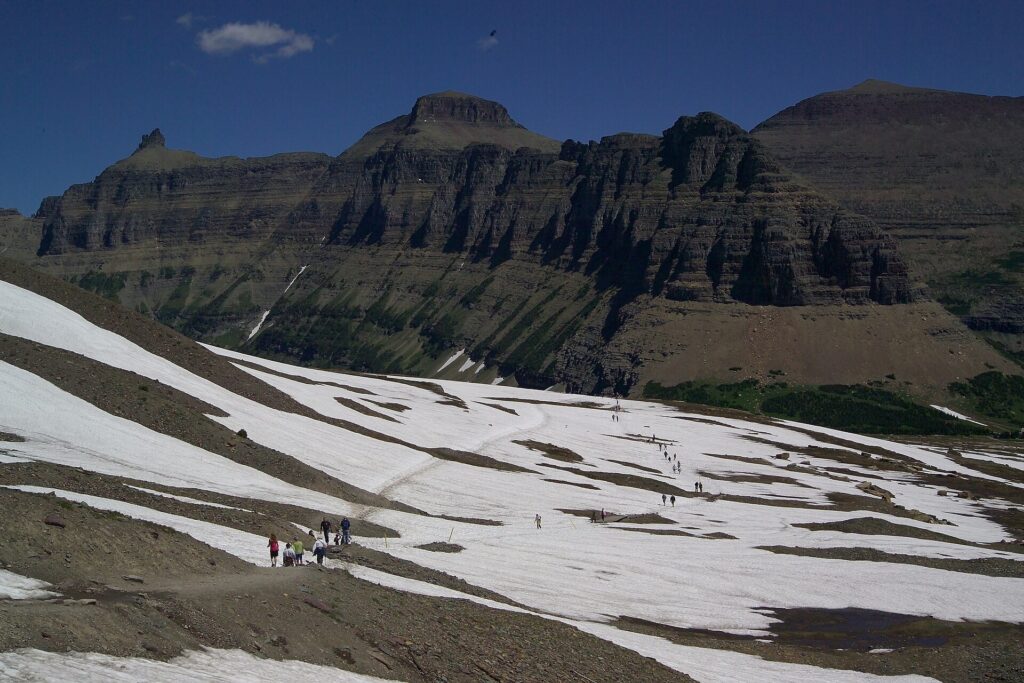
From the pass, Hidden Lake Overlook is 1.3 miles one way with 608 feet of climbing. The trail climbs on stairs and switchbacks behind the visitor center. Give it a clear morning and expect company.
Glacier National Park shuttle
In 2026 the shuttle ran from July 1 through Labor Day, September 7. West-side buses left from Apgar Visitor Center and Lake McDonald Lodge. East-side buses left from St. Mary Visitor Center and Rising Sun. All of them went to Logan Pass.
The shuttle page listed a $1 processing fee per ticket, sold only through Recreation.gov. The last westbound bus left the pass at 7:30 pm and the last eastbound at 8:00 pm. Miss it and there is no other ride back to your car, so the shuttle is a round trip from where you park and not a way to cross the park.
Glacier National Park red bus tours
Glacier National Park Lodges runs the red buses. Each carries a maximum of 16 passengers plus a driver, and the season follows the road. In 2026 the operator listed the Western Alpine tour at 3 to 4 hours for $80 to $90 per adult. The Eastern Alpine tour ran 2.5 to 3.5 hours for $66 to $74 per adult, depending on pickup.
Both started June 20, and they ended October 2 and September 25 respectively. I would book a west-side red bus for the road if the Logan Pass lot looked hopeless. It takes the parking and the narrow-road nerves off the day, and it frees you to look up.
Many Glacier
Day three is the east side. Many Glacier is 20 miles and about 40 minutes from St. Mary. Start early and treat the drive as part of the day.

The easy headline hike here is Grinnell Lake. It is 3.4 miles with 60 feet of climbing on foot, or 1.1 miles if you take the concession boat from the hotel, and boat fees apply. The longer Grinnell Glacier hike is 5.3 miles with 1,600 feet of climbing. I would keep it off a four-day plan unless the weather and the whole group are strong.
Wildlife is the real hazard at Many Glacier, so carry bear spray and keep the group together. The park prohibits approaching within 100 yards of bears or wolves. Keep 25 yards from everything else, which matters when a bear is standing in the trail.
Two Medicine
Two Medicine is 34 miles and about an hour from St. Mary. It is also the day to hold loosely. The park’s construction page, dated September 15, 2026, said Two Medicine Road would close at the Highway 49 junction from mid to late September 2026, for rehabilitation work running through late 2027. The campground was closed for the 2026 season. Check that page before you count on day four.

If the road is open on your dates, take the short walks. Running Eagle Falls is 0.3 miles one way. Aster Falls is 1.2 miles one way with 100 feet of climbing. A concession boat runs from the south shore if you want a shorter route to the head of the lake.
If the road is closed, swap in a second Logan Pass morning. Or drive the North Fork toward Polebridge, 28 miles and about an hour from West Glacier. The same construction page lists October 2026 water-system work there, with a full closure toward Logging Creek, so confirm that road too.
What should I pack for Glacier National Park?
Pack for three seasons in one day. Logan Pass is high and the weather is unpredictable. The Apgar shoreline at breakfast is a different climate from the pass at noon.
- Bring: a rain shell, a warm mid-layer, a hat and sunglasses, sturdy shoes with grip, and a refillable bottle.
- Bring: bear spray within reach, a paper map or a downloaded one, and snacks for the trail.
- Leave: bear bells, which the park calls neither adequate nor effective, and the fourth fleece you packed just in case.
Our national park road trip packing list covers the car side. The national park camping checklist covers a tent night. Budget the trip with our national park road trip cost guide. Our Yellowstone itinerary uses the same logic if you are stringing two parks into one Mountain West trip.
Glacier National Park bear spray
Carry bear spray where you can reach it in a second, not buried in the pack. The park calls it the most effective deterrent. It is meant to be sprayed into the face of an oncoming bear. Distance, wind, rain, temperature extremes and the can’s shelf life all change how well it works.
Hike in a group of four or more where you can. The park has no reported attacks on groups that size. Call out and clap at regular intervals instead of wearing a bell. TSA keeps its own listing for bear spray, so read it before you pack the can in a carry-on.
Glacier National Park questions
Do you need a reservation for Glacier National Park?
No, not for a vehicle in 2026. Vehicle reservations are not required, although the shuttle uses tickets and Logan Pass has three-hour timed parking. Check the park’s reservation page for the season you are visiting.
Is Glacier National Park worth visiting?
Yes, and I would give it four days rather than two. The park is spread out and each area feels different. The west side is a big lake and old cedars, the road is the high alpine drive, and the east side is a string of lakes under big peaks. A short trip forces a choice that a longer one does not.
Do you need bear spray in Glacier National Park?
Yes, I would carry it on every trail. The park calls bear spray the most effective deterrent and says to keep it in an accessible spot. The park also holds nearly one thousand bears, which is a good argument for the can.
Is Going-to-the-Sun Road open in October?
Not all of it for long. The alpine sections typically close around the third Monday of October, while the section near the West Entrance stays open year-round. Check the park’s current conditions the morning you drive.
Prices are approximate, current as of publication, and change frequently — confirm the latest price with the retailer before buying.
Published October 19, 2026.
Photo credits: (1) featured, Reynolds and Clements mountains rising… — National Park Service, U.S. Government work, public domain, via Wikimedia Commons; (2) Lake McDonald in Glacier National Park with… — TLJones007, CC BY-SA 4.0, via Wikimedia Commons; (3) Snowfield below a cliff band with small… — National Park Service, U.S. Government work, public domain, via Wikimedia Commons; (4) Grinnell Point rising above Swiftcurrent… — National Park Service, U.S. Government work, public domain, via Wikimedia Commons; (5) Two Medicine Lake shoreline near the boat… — National Park Service, U.S. Government work, public domain, via Wikimedia Commons.