

Some links on our site may earn us a commission at no extra cost to you. Learn more.
Elephant Rocks State Park sits along Highway 21 in Missouri’s St. Francois Mountains. A hillside of 1.5-billion-year-old pink granite boulders, some the size of a school bus, line up end to end like a train of circus elephants. Entry is free. The main loop takes under an hour, and a paved Braille Trail carries wheelchairs and strollers right up to the formation. It’s an easy detour off Highway 21, and one of the few Ozark stops where kids are encouraged to climb on the scenery.
I’ve pulled off for Elephant Rocks more than once, usually between a float trip on the Current and the long drive back to the interstate. It’s the kind of stop that resets a car full of kids. Twenty minutes of scrambling over warm granite does more than another rest-stop snack ever will. My nieces and nephews always want to climb straight to the top of the biggest boulder, and I always let them; there’s nowhere for anyone to actually fall far.
Where Is Elephant Rocks State Park in Missouri?
The park is at 7406 Highway 21 in Belleview, in Missouri’s Arcadia Valley, about 90 miles south of St. Louis. It sits in Iron County, a few miles north of Ironton and Pilot Knob. Highway 21 runs straight through, connecting Potosi to the north and Ironton to the south. This stretch of the Ozarks is old, worn-down mountain country, not the flatter farmland most people picture when they think of Missouri. Granite hills show up in road cuts for miles in every direction.
Graniteville, the tiny community that grew up around the old quarry, is next door. It’s really just a scatter of houses and the park entrance itself. Parking is simple: the lot sits directly off Highway 21, and the granite outcrop is visible from the road. Coming from the west, Farmington is the nearest town of any size with gas stations and a grocery store.
Day Trips From St Louis
Elephant Rocks is one of the easiest state park stops to add to a St. Louis weekend. The drive down Highway 21 takes about an hour and a half. The park itself doesn’t need more than half a day; most families spend 60 to 90 minutes on-site before moving on.
That makes it easy to pair with a second stop. Ironton’s historic square is five minutes away. The drive continues on to the Arcadia Valley’s other granite and river attractions if there’s daylight left. Most St. Louis visitors come down I-55 to Festus, then pick up Highway 21 south the rest of the way. Pack a cooler; there’s no food service beyond an occasional weekend food truck.
Elephant Rocks State Park Hours
The park’s hours shift with the season — 8 a.m. to 8 p.m. from mid-April through August, tightening to 8 a.m. to 5 p.m. in the winter months, with a couple of shoulder-season adjustments in between. Staffed buildings close on major holidays like Thanksgiving and Christmas, though the grounds themselves stay open. Fall is my favorite window. Crowds thin out after Labor Day, and the oak and hickory ridges around the boulders turn color right alongside the rest of the Ozarks.
Plan an early or late visit in summer if crowds are a concern. The parking lot is small, and it fills by midmorning on a nice Saturday.
Are Missouri State Parks Free?
Yes. Missouri charges no day-use entrance fee at Elephant Rocks or any of its state parks. The system runs on a dedicated conservation sales tax instead of a gate fee. Bring cash anyway if a food truck is parked at the entrance; that’s a separate, private vendor.
Elephant Rocks State Park Braille Trail
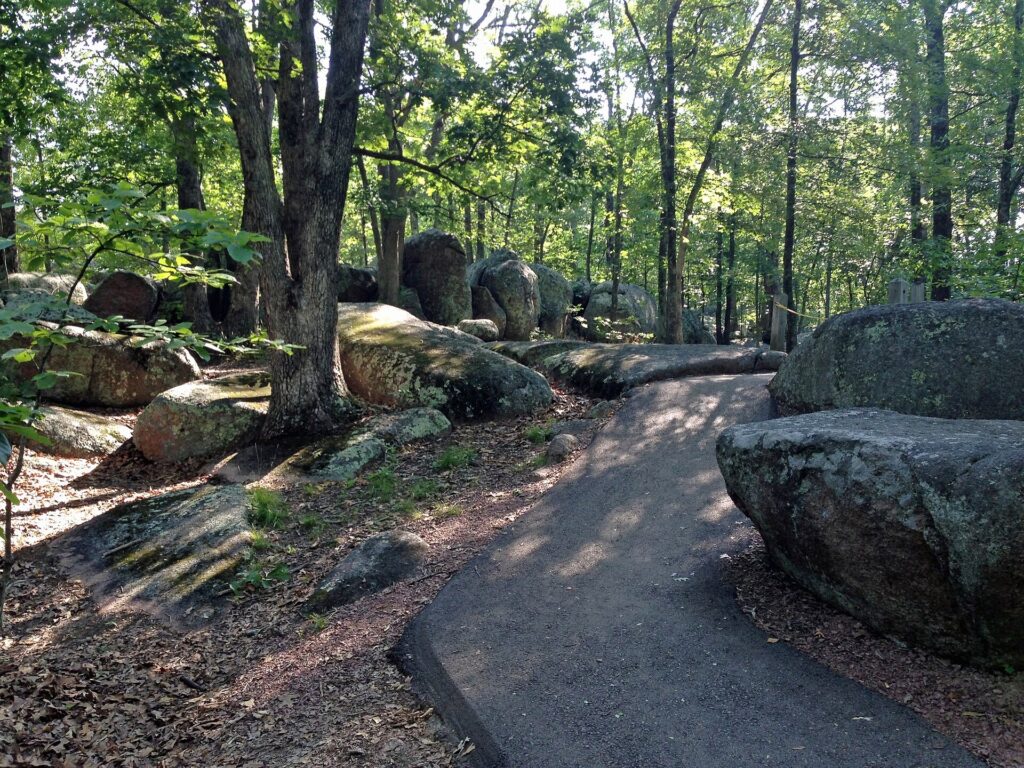
The signature trail here is paved, one mile long, and was built specifically for visitors with visual and physical disabilities. Carpet patches and a hand-rope mark each interpretive stop. The panels are printed in Braille alongside standard text. Even without the accessibility features, it’s simply the easiest way to see the boulders: gentle grades, mostly shaded, looping past the biggest formations before ending near the engine house ruins.
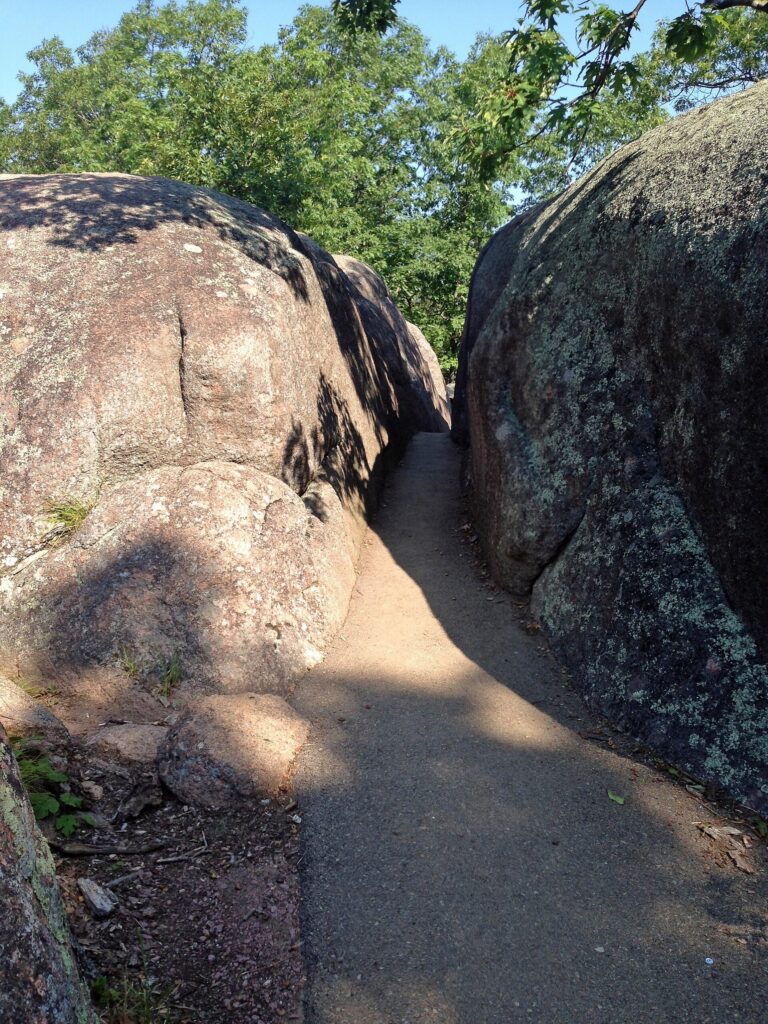
A handful of sections narrow to under 30 inches where the rock closes in. A couple of short grades get steep enough to notice if you’re pushing a stroller. The park loans out powered track chairs for visitors who need them, with 48 hours’ notice by phone to reserve one.
How Long Is the Trail at Elephant Rock State Park?
Most visitors are in and out in an hour. The Braille Trail loop is the main event at a mile. The Engine House Ruins spur branches off it for a short out-and-back to the old quarry building. Neither trail is technical; both are walkable in sneakers.
| Trail or area | Distance | Typical time | Accessibility |
|---|---|---|---|
| Braille Trail loop | 1 mile (paved) | 30–45 min | Paved; track chairs by reservation |
| Engine House Ruins spur | Short spur off the loop | 10–15 min | Paved, narrows near the ruins |
| Boulder scrambling area | — | 15–30 min | Uneven granite, not stroller-friendly |
Add the drive-in time, and ninety minutes covers a relaxed visit for most families.
Missouri Red Granite
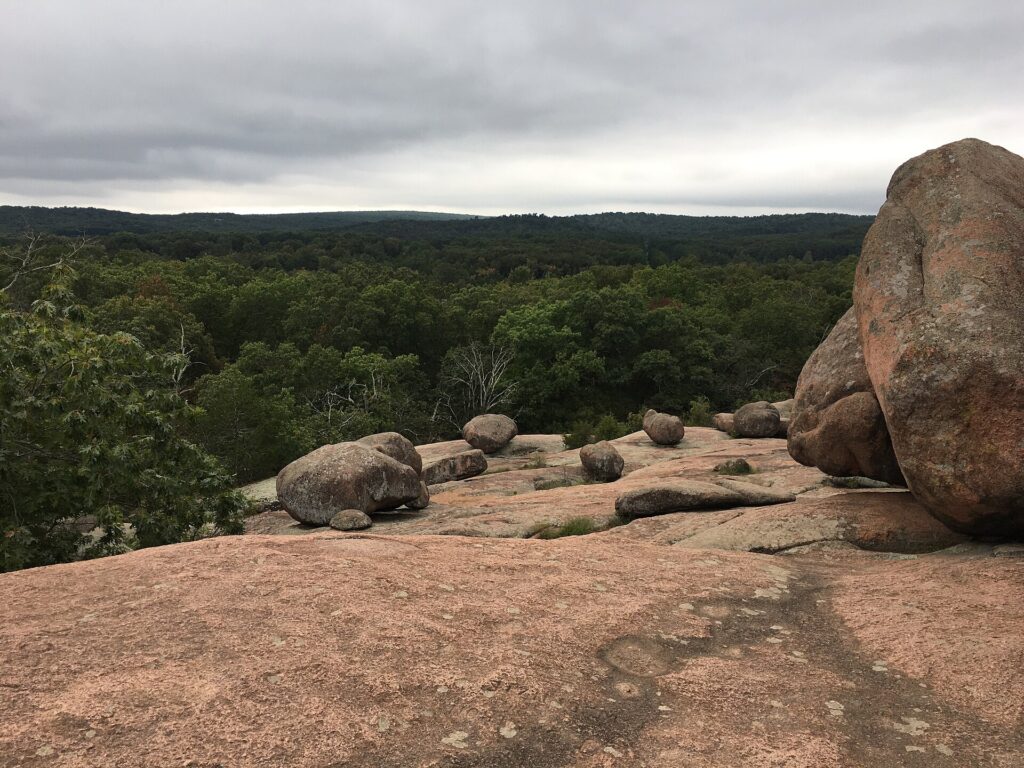
The boulders are 1.5 billion years old, among the oldest exposed rock in Missouri. They didn’t get their rounded shape by tumbling downhill. Magma cooled underground into solid granite and cracked along horizontal and vertical seams. Groundwater worked through those cracks for millions of years, rounding the corners while the rock was still buried. Erosion eventually stripped away the softer material on top and left the rounded “core stones” sitting exposed, a formation geologists call a tor.
Up close, the color isn’t a flat pink. Patches of gray and orange lichen crust over parts of nearly every boulder, and the surface has a coarse, speckled texture from the individual mineral grains. That texture is exactly what gives the rock its grip; it’s part of why the boulders are safe enough to let kids climb.
Lichen keeps working on them even now, producing a mild acid that slowly dissolves the surface. Freeze-thaw cycles pop off flakes a little at a time. It’s the same fine-grained pink granite, sold historically as “Missouri Red,” that shows up in buildings across St. Louis.
Elephant Rocks State Park History
Commercial quarrying started here in 1869. By the 1890s, the Sheehan Quarry was cutting Missouri Red granite for some of St. Louis’s biggest projects: facing stone for the piers of the Eads Bridge, paving blocks for the riverfront and downtown streets, and stone for the Governor’s Mansion in Jefferson City. Peak output ran between 1880 and 1900. By 1902, sixteen rail cars a day hauled finished granite out on the Iron Mountain and Southern line.
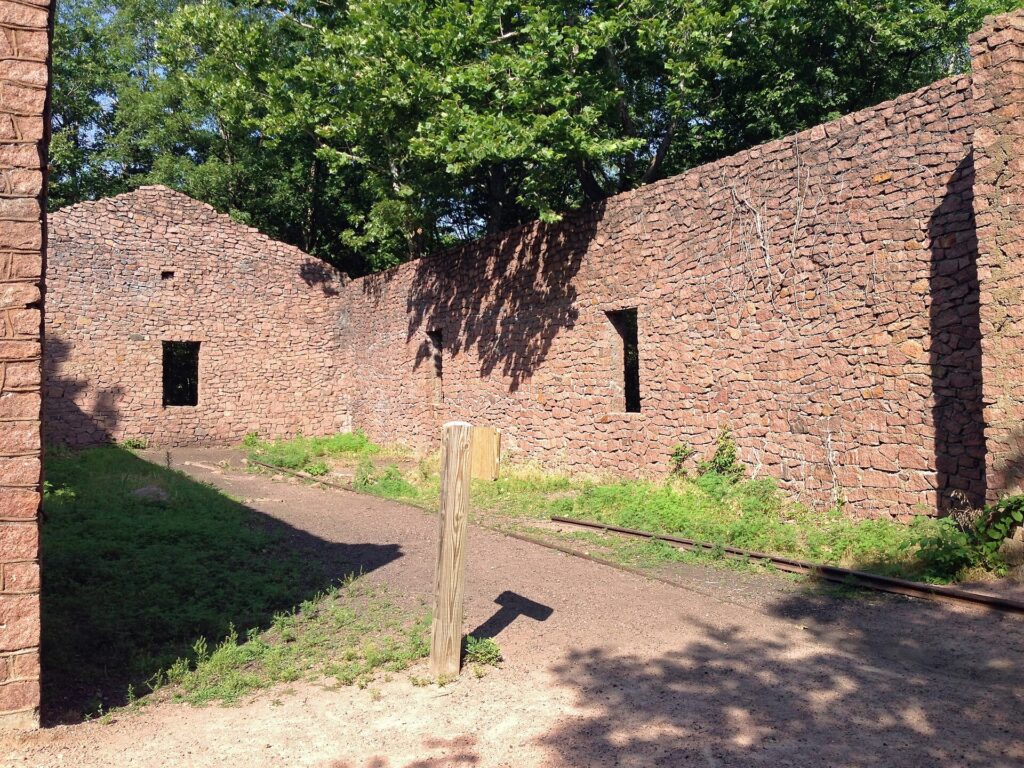
The ruined engine house along the Braille Trail is what’s left of that operation. It’s a stone building where crews repaired the small train engines that moved granite cars around the quarry floor. Walking through the roofless walls today, it’s easy to picture how loud and industrial this quiet hillside used to be. The window and door openings are still square-cut from the same pink granite as the boulders around it, which is a nice detail if you’re looking for it.
Things To Do In Ironton Missouri
Elephant Rocks doesn’t have a campground, so anyone staying overnight needs to look elsewhere in the Arcadia Valley. Johnson’s Shut-Ins State Park, about fifteen minutes south, has the closest public campground. Ironton itself has a handful of small motels around its historic square, and Farmington has more chain options if the smaller towns are full.
For a bigger regional loop, this corner of the Ozarks connects easily to the Ozark National Scenic Riverways. Spring-fed rivers like the Current River stay cold and clear well into summer. I’ve floated stretches of it on hot July afternoons. It’s a natural pairing with a granite-boulder morning: cool water after a warm scramble.
Things to Do Near Elephant Rock State Park With Kids
This is one of the few state parks where climbing on the scenery is the point. Kids scramble over the lower boulders while parents stick to the flatter ledges. The squeeze trail is usually the highlight of the visit.
The picnic area has scattered tables in the shade near the parking lot, plus a small playground for anyone who needs a break from rock-climbing. Pack more water than seems necessary. There’s no shade on the granite itself, and it holds heat straight through a Missouri afternoon. Closed-toe shoes matter more than they look like they should; the granite grit is rough on bare feet and flip-flops slide. A basic gear checklist covers what’s worth throwing in the car for a stop like this, and I’d rather over-pack a cooler than turn around for one.
Can You Swim at Elephant Rocks State Park?
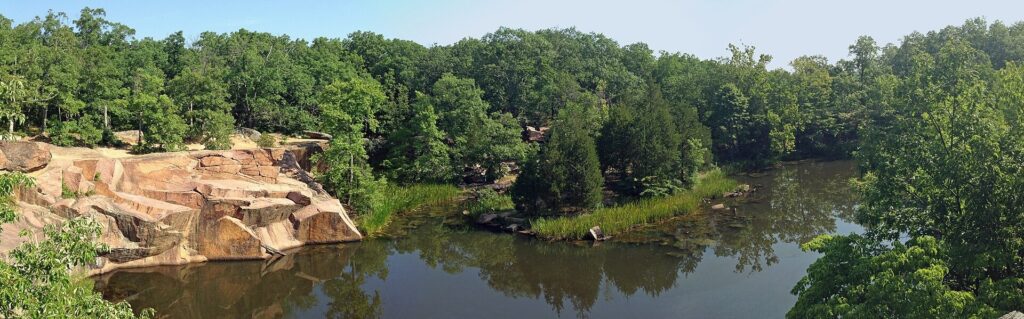
No. There’s no swimming area at Elephant Rocks. The old quarry pond near the park boundary looks inviting, but it isn’t set up or monitored for swimming, and the water sits well below the surrounding rock ledges. Save the swimming for the Current River nearby.
Are Dogs Allowed at Elephant Rocks State Park?
Yes, kept on a leash. Dogs are welcome on the Braille Trail and throughout the picnic area, same as most Missouri state parks. Their paws will feel the heat on bare granite in summer, so plan an early visit if you’re bringing one.
How Far Is Elephant Rock State Park From St Louis?
About 90 miles, roughly an hour and a half by car down Highway 21. It’s a straightforward drive with no mountain passes or narrow roads. That makes it an easy add-on to a longer Ozarks trip.
How Big Is Elephant Rock State Park?
It’s a small park by Missouri standards, built around one striking hillside rather than a sprawling trail system. Most of a visit happens within a few hundred yards of the parking lot. That’s part of why it works so well as a quick stop, and why I’ve never needed more than a single afternoon here even with kids in tow.
Published September 28, 2026.
Photo credits: (1) featured, Rounded pink granite boulders stacked into… — Fredlyfish4, CC BY-SA 3.0, via Wikimedia Commons; (2) Paved trail winding between large granite… — Fredlyfish4, CC BY-SA 3.0, via Wikimedia Commons; (3) Narrow gap between two giant granite… — Fredlyfish4, CC BY-SA 3.0, via Wikimedia Commons; (4) Stone engine house ruins from the old… — Fredlyfish4, CC BY-SA 3.0, via Wikimedia Commons; (5) Water-filled former quarry pond surrounded… — Fredlyfish4, CC BY-SA 3.0, via Wikimedia Commons.