

Some links on our site may earn us a commission at no extra cost to you. Learn more.
Old San Juan packs two centuries-old Spanish forts and a UNESCO-listed old town into about seven walkable blocks. It sits right next to the cruise pier. In one morning you can climb both national park forts and cross the promenade along the old city wall. You’ll still make it back to the ship before the all-aboard call. It’s small enough to see on foot. That’s the whole reason it works so well as a cruise stop or a long weekend on its own.
I’ve walked into Old San Juan straight off a ship more than once, nieces and nephews in tow, and the pattern never changes. Everyone packs like we’re headed into a rainforest. All I’ve ever actually needed is sandals, a hat, and sunscreen. It’s a city built for wandering between two forts and a plaza. Not for the daypack somebody always insists on bringing anyway.
Best Things to Do in Old San Juan

The short list: both forts, the seaside promenade, the governor’s mansion, and the umbrella-covered shopping street. All of it sits within a fifteen-minute walk of each other and the cruise pier. Nothing here requires a car, and most of it costs little or nothing.
- Castillo San Felipe del Morro, the fort at the harbor mouth
- Castillo San Cristóbal, the larger fort guarding the land side
- Paseo de la Princesa, the promenade along the old city wall
- La Fortaleza, the governor’s residence and oldest executive mansion still in use in the Americas
- Calle Fortaleza, the street strung with colored umbrellas
| Site | Cost | Time to See It |
|---|---|---|
| El Morro & San Cristóbal (one combined ticket) | $10 per adult; 15 and under free | 1.5–2 hours for both |
| La Fortaleza guided tour | Free | About 30 minutes |
| Paseo de la Princesa | Free | 20–30 minutes |
| Calle Fortaleza | Free (shopping and drinks extra) | 15–20 minutes |
| Old San Juan trolley | Free, when running | Varies by route |
Castillo San Felipe del Morro
El Morro sits at the harbor mouth on six levels of stacked stone. It was built to watch the water, not the town, and that’s still the reason to visit. The views run straight out to the Atlantic with nothing in the frame but ramparts and ocean. The National Park Service sells a single ticket that also covers San Cristóbal. It runs $10 per adult, free for visitors 15 and under. It stays valid for 24 hours at both forts, per the park’s fee page. The entrance booth does not take cash, so bring a card.
Give it an hour if you’re only doing El Morro. Go longer if you want every level and the lighthouse end too. The open lawn out front, the Explanada, is where kite flyers gather most afternoons. It’s a good spot to let kids run before or after the tunnels inside. Wear real shoes. The stone is uneven in spots and slick when it rains, which in San Juan is often.
Castillo San Cristóbal San Juan

San Cristóbal is the bigger of the two forts. It’s the one most people skip in favor of El Morro’s better photo angle. That’s a mistake. It was built to defend against a land attack, not a naval one. The layout is a maze of separate defensive posts, connected by tunnels and dry moats, instead of one open structure. The same combined ticket covers it. Current hours are posted on the park’s hours page. Worth checking, since both forts occasionally shift their schedule around holidays.
The tunnels are the part kids remember. Bring a flashlight, or just use a phone. Some stretches are genuinely dark. San Cristóbal also has the better view back over the old town roofs. Good if you’d rather photograph the city than the harbor.
Paseo de la Princesa
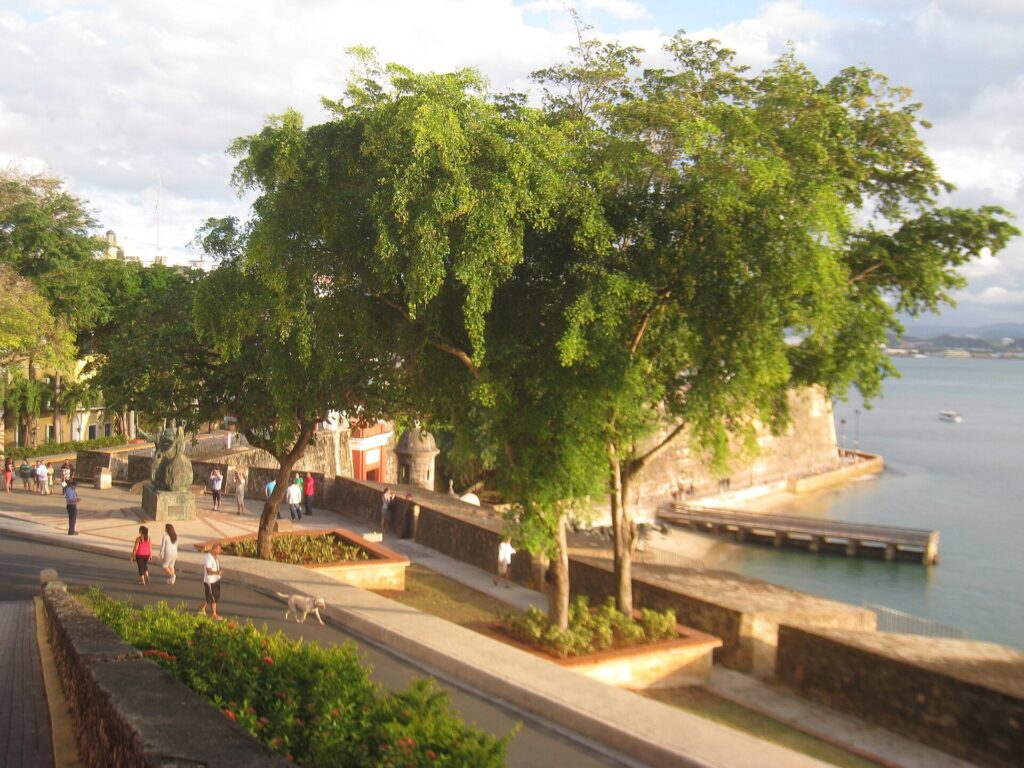
This promenade runs along the base of the old city wall, from the cruise piers toward La Fortaleza. It’s the easiest stretch of Old San Juan to fall in love with in the first ten minutes. Royal palms line one side. The harbor sits on the other. Street vendors and musicians tend to set up near the Raíces Fountain at the far end.
The blue-tinged cobblestones you’ll notice here, and through most of the old town, aren’t paint. They’re adoquines, cast from slag left over from Spanish iron smelting. Ships hauled them over as ballast, then unloaded them to pave the streets. They’ve been down since the 1700s, and they’re still slippery when wet. Factor that into your shoes here too. Paseo de la Princesa connects straight to the piers. That makes it the natural starting point if you’re arriving by ship.
La Fortaleza Puerto Rico
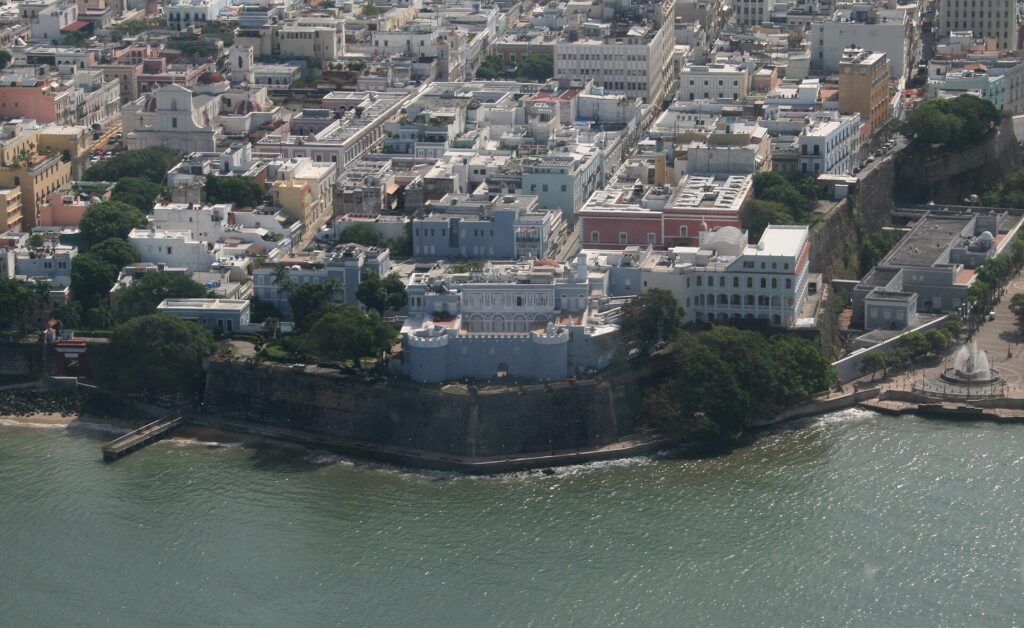
La Fortaleza is the governor’s official residence. It’s also the oldest executive mansion in continuous use anywhere in the Americas. It began as a defensive fort in the 1530s, before the harbor-mouth forts existed. That’s why it looks less like a palace and more like a fortified house with gardens grafted on later.
Guided tours run free on weekdays. They take you through the gardens and, when the governor’s office isn’t in session, parts of the interior. Because it’s an active government building, it can close without notice. Photo ID is required for anyone 21 and older. Call ahead, or check with the tour desk the same day, rather than planning your whole afternoon around it.
Calle Fortaleza

Calle Fortaleza is the street strung with hundreds of colored umbrellas overhead. It’s become the single most photographed block in Old San Juan for a simple reason. The light coming through turns the whole street a different color, depending on where you stand. It’s also just a good street for lunch. More casual restaurants and bars per block than almost anywhere else in the old town.
Go earlier in the day if you want the street mostly to yourself for photos. By evening it fills in with the dinner crowd. That’s fine if that’s what you’re there for. It’s just not a quiet fifteen minutes anymore.
How to Get Around Old San Juan
Walking covers nearly everything in this guide. The old town is a compact grid, seven blocks by seven blocks. Every major site sits inside that grid or right at its edge. If your ship docks at the piers, you can walk to both forts, La Fortaleza, and Calle Fortaleza. No taxi needed.
Old San Juan has also run a free trolley through the old town for years. Routes connect the forts, the piers, and the shopping streets. It’s a genuine option on a hot afternoon, or for anyone who doesn’t want the hills. Service on it has been inconsistent lately. Check with the pier’s tourism kiosk or your ship’s excursion desk the day you’re there, rather than counting on a fixed schedule. If you’d rather skip the walk back uphill from the forts, a short taxi is easy to flag down from any of the main plazas. It’s inexpensive too.
Do You Need a Passport to Go to Puerto Rico?
No. Puerto Rico is a U.S. territory. U.S. citizens flying or sailing in from the mainland need only a government-issued photo ID, not a passport. That’s confirmed by Puerto Rico’s own Department of State. The currency is the U.S. dollar. Phones work on regular domestic plans. English is widely spoken in the tourist areas, though Spanish is the language you’ll hear on the street.
That combination is part of why Old San Juan works so well as a first international-feeling trip. Good for a family without passports sorted out yet, and an easy add-on to a longer Caribbean cruise. If you’re continuing on to islands that do require a passport, our cruise packing list can help. It covers what to keep in your carry-on for a multi-stop itinerary. TSA PreCheck won’t buy you anything on this particular leg, since there’s no customs line to skip. Headed somewhere international afterward? Our TSA PreCheck vs Global Entry vs CLEAR comparison is worth a look before you fly.
Who Invented the Pina Colada?
Puerto Rico claims the piña colada as its official drink. Old San Juan is where the two competing origin stories both live, about four blocks apart. The Caribe Hilton, just outside the old town, says its bartender Ramón “Monchito” Marrero invented the drink in 1954. Barrachina, a restaurant inside Old San Juan proper, credits its own bartender, Ramón Portas Mingot, with creating it in 1963.
Neither claim has ever been settled. Puerto Rico’s tourism board has never picked a side either. Order one at both if you want to judge for yourself. Most bars in Old San Juan will make one, regardless of which side of the argument they’re on.
Is Old San Juan Worth Visiting?
Yes, and it earns that in a single afternoon, which is rare for a historic district. Between two national park forts, a governor’s mansion, and a walkable cruise pier, it packs in a lot. More per hour than almost anywhere else in the Caribbean.
Is Old San Juan walkable?
Yes. The historic district is a compact grid, about seven blocks by seven blocks. Every site in this guide sits inside it, or right at the edge. The main challenge is the hills and the uneven cobblestones, not the distance.
How long does it take to walk Old San Juan?
Most of the old town can be covered on foot in two to three hours at an easy pace. That’s not counting time inside the forts or La Fortaleza. A full day lets you add both forts and lunch on Calle Fortaleza. Time to sit along Paseo de la Princesa too, without rushing.
Is Old San Juan safe at night?
The main tourist streets around the plazas and Calle Fortaleza stay busy and well lit well into the evening. As in any old city with narrow streets, stick to the lit, populated blocks after dark. Treat the quieter side streets the way you would anywhere unfamiliar.
What is Old San Juan known for?
Its two Spanish colonial forts, the blue-tinged cobblestone streets, and brightly painted colonial buildings. It also carries a contested but proudly kept claim to being the birthplace of the piña colada.
Prices are approximate, current as of publication, and change frequently — confirm the latest price with the retailer before buying.
Published October 3, 2026.
Photo credits: (1) featured, Castillo San Felipe del Morro on the… — Mariordo (Mario Roberto Durán Ortiz), CC BY-SA 4.0, via Wikimedia Commons; (2) A cobblestone street lined with colorful… — MusikAnimal, CC BY-SA 4.0, via Wikimedia Commons; (3) La Fortaleza, the governor's residence in… — Jaro Nemčok, CC BY-SA 3.0, via Wikimedia Commons; (4) Umbrella decorations over Calle de la… — Mariordo (Mario Roberto Durán Ortiz), CC BY-SA 4.0, via Wikimedia Commons.