

Some links on our site may earn us a commission at no extra cost to you. Learn more.
Great Sand Dunes National Park holds the tallest dunes in North America. They sit against the Sangre de Cristo Mountains in southern Colorado, about four hours from Denver. You pay $25 per car, walk out across a shallow creek in late spring, and climb sand ridges that top 700 feet. Most people give it one long day. Dunes at dawn, sledding, a wade in Medano Creek if it is running, then the Milky Way after dark.
I have been coming down to Great Sand Dunes for years. It is usually the detour on a run to the Arkansas River or the hot springs. The first climb humbles everybody. Every step up a dune face slides you half a step back. By the second ridge your calves know it. Go early and carry twice the water you think you need. Wear closed shoes you do not mind filling with sand.
Is Great Sand Dunes worth visiting?
Yes, and I would put it ahead of several better-known Colorado parks for a single day. Nothing else in the state feels like it. You crest a ridge of sand above 8,000 feet. Snow peaks fill one side of the view and the flat, dry San Luis Valley fills the other.
The catch is the drive. The park sits in the San Luis Valley, a long way from I-70 and from the attractions people try to pair it with. Plan it as the anchor of a southern loop or the overnight stop on the way to northern New Mexico. Then it earns the miles.
Skip it if you only have a half day and hate heat. The sand is hot by 10 a.m. in summer, the afternoons bring lightning, and there is no shade on the dunefield. On a bad wind day the sand takes the skin off your shins. Pick your hours and it is a great park; ignore them and it is a miserable one.
Great Sand Dunes entrance fee
Entry is $25 per private vehicle for seven days, $20 per motorcycle, and $15 per person on foot or bicycle, per the park’s fee page. A Great Sand Dunes annual pass is $45, and the America the Beautiful pass covers it. The per-person rate starts at age 16.
There is no timed entry, no reservation, and no visitor cap. The park itself is open 24 hours a day all year. You can be on the sand before sunrise and out on it again for the stars. The visitor center keeps 9 a.m. to 4:30 p.m. hours, closed on Thanksgiving, Christmas and New Year’s Day.
| Pass | Price | Good for |
|---|---|---|
| Private vehicle | $25 | 7 days, everyone in the car |
| Motorcycle | $20 | 7 days |
| Walk-in or bicycle, age 16+ | $15 | 7 days |
| Great Sand Dunes annual pass | $45 | 1 year, this park only |
| America the Beautiful annual | $80 | 1 year, all federal fee sites |
| Senior lifetime (62+) | $80 | Lifetime |
| Fee-free days 2026 | $0 | Feb 16, May 25, Jun 14, Jul 3–5, Aug 25, Sep 17, Oct 27, Nov 11 |
Pay at the entrance station on Highway 150. Cell service in the valley is spotty, so do not count on buying a pass online from the road. If you are stringing several parks together, the national park road trip cost guide runs the pass math.
Great Sand Dunes Medano Creek
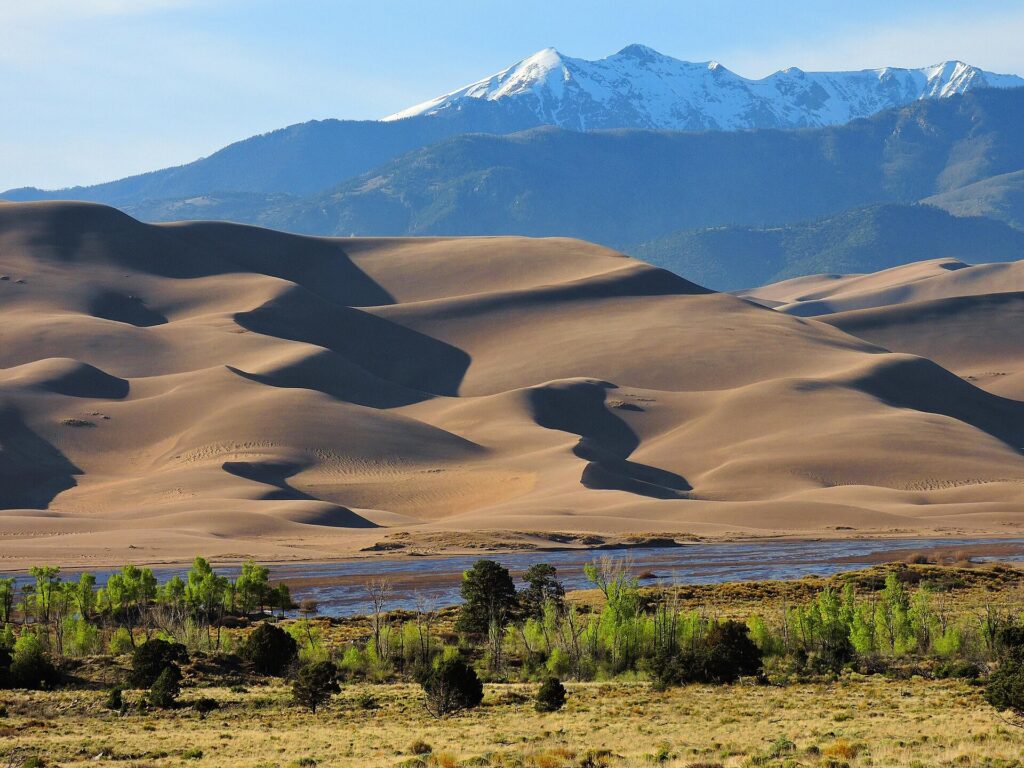
Medano Creek is the shallow, braided stream that runs along the base of the dunes for a few weeks each spring. For those weeks the park is Colorado’s beach. In an average year it starts flowing in April and peaks in late May or early June at around 40 cubic feet per second. The park’s creek page has it dry at the main parking lot by early July. Snowmelt drives all of it.
The thing everyone comes for is surge flow. Sand ridges build up on the creek bed, collapse, and send a pulse of water downstream every minute or so. In a decent snow year the waves are deep enough for kids to float a few yards on an inflatable. It is ankle to shin deep, cold in the morning and pleasant by afternoon.
Do not build a trip around the creek without checking. The 2026 water year was one of the driest on record and the creek never reached the main lot this spring. In a year like that the only water is a mile upstream from the horse-trailer parking, or up the 4WD road at Castle Creek. Not much of a beach. Memorial Day weekend is the peak crowd whether the creek shows up or not.
Great Sand Dunes sandboarding

Sandboards and sand sleds are the main event for anyone under 30 and most people over it. The park does not rent them, and nothing you bring from home works. Cardboard, snow saucers and plastic sleds dig in and stop dead. You need a board with a slick base and sand wax, and those come from shops outside the gate.
The closest is Great Sand Dunes Oasis, four miles from the entrance on Highway 150. It rents boards and sleds at $20 a day plus tax, 8 a.m. to 5 p.m., with returns by 4:30. Spindrift Sandboards in Blanca charges the same daily rate. Kristi Mountain Sports in Alamosa is the option if you are staying in town. Rent the day before if you want a dawn start.
| Rental shop | Where | Distance from park | Daily rate |
|---|---|---|---|
| Great Sand Dunes Oasis | Highway 150 at the entrance | 4 miles | $20 + tax |
| Spindrift Sandboards | Blanca, CO | 26 miles | $20 + tax |
| Dune Valley Distillery | Mosca, CO | 23 miles | Check with shop |
| Kristi Mountain Sports | Alamosa, CO | 36 miles | Check with shop |
You can slide anywhere on the dunefield away from plants. The first real slopes start about 0.7 miles from the main lot. The first high ridge is 1.25 miles out, and that is where the long runs are. Damp sand after rain is the fastest surface; bone-dry afternoon sand is slow. Every run down means a slog back up, so budget two hours and a lot of water.
High Dune vs Star Dune

High Dune is the one to do. It is the big ridge you see from the parking lot, 2.5 miles round trip with 688 feet of climb. Most people take about two hours. It is not the tallest dune in the park. The view from the top covers the whole dunefield, and it is where I send anyone with one morning.
Star Dune is the long day. Six miles round trip, 736 feet of gain, and six hours at a normal pace. Add more if you are not used to the altitude. The park’s hiking page now ranks Hidden Dune the tallest in North America at 741 feet, with Star Dune second. The same page warns that afternoon sand can hit 150°F. Neither has a trail; you pick a line along the ridges and go.
Walk the ridgelines, not the faces. Ridge sand packs harder and you slide less. Start by 7 a.m. in summer, turn around when the thunderheads build over the Sangres, and keep your shoes on. Morning sand is cold enough to numb bare feet; by early afternoon it will blister them.
Pinon Flats Campground
Piñon Flats is the only campground inside the park, just past the dunes parking lot at 8,175 feet. It has 88 sites plus three group sites, flush toilets, bear boxes and no showers or hookups. It runs April 1 through October 31. Every site is by reservation only on Recreation.gov; there is no first-come line.
Book it the day the window opens for late May through September. The sites are small, many are unlevel, and the combined vehicle-plus-trailer limit is 35 feet. Your entrance pass is separate from the camping fee. Our national park camping checklist covers what to bring. Add a tarp for the tent floor, because sand gets in anyway.
Zapata Falls is the best add-on and the backup campground. Eight miles south of the visitor center, a rough 3.5-mile dirt road climbs to a BLM trailhead. From there it is a half-mile walk to a 30-foot waterfall hidden in a rock crevasse. You wade the creek to see it. Bring water shoes. In winter the falls freeze solid and the trail turns to ice. The view back across the dunefield from the parking area is worth the drive by itself.
Best time to visit Great Sand Dunes
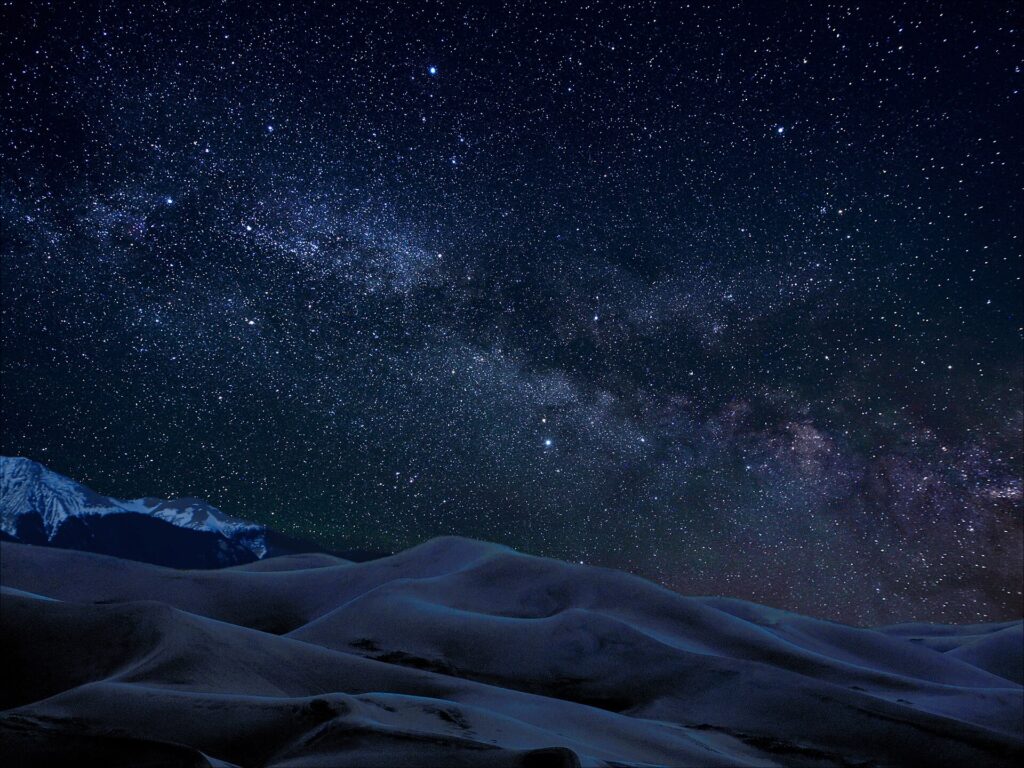
Late May to mid-June if you want the creek; September if you want the dunes to yourself. Summer highs sit in the 70s, but the sand is the number that matters. It is far hotter than the air by late morning. Spring is windy enough to sandblast you, and March and April are the snowiest months.
| Season | Air temps | What you get | What to plan around |
|---|---|---|---|
| April–mid May | Highs 30s–60s | Creek starting, few people | Wind, late snow |
| Late May–June | Highs 60s–70s | Peak creek, surge flow | Memorial Day crowds, full campground |
| July–August | Highs 75–80, nights 40s | Best Milky Way, ranger programs | 150°F sand, afternoon lightning |
| September–October | Highs 60s–70s, nights 20s–30s | Cool sand, aspen color, quiet | Campground closes Oct 31 |
| November–March | Highs teens–30s, lows to −15 | Snow on the dunes, empty park | Bitter cold, campground closed |
The park is a certified International Dark Sky Park, and the dunes are the viewing platform. August and September give the best Milky Way. You want a moonless night and at least an hour and a half after sunset. Bring a red headlamp and walk out a quarter mile from the lot; the sky does the rest.
My own pick is the last week of September. The sand is cool enough to hike at noon and the cottonwoods along the creek bed have turned. The campground has space midweek. Pair it with a soak in Glenwood Springs on the way back north and the dunes become the opener of a southern Colorado loop.
Great Sand Dunes National Park facts
How much time do you need at Great Sand Dunes National Park?
One full day covers it. High Dune at sunrise, sledding until the sand heats up, the creek in the afternoon if it is flowing, and stars after dark. Camp one night at Piñon Flats and you get the dawn and the night sky without the long drive on either end.
Can you sled at Great Sand Dunes?
Yes, anywhere on the dunefield away from vegetation, but only on a real sandboard or sand sled. Cardboard and snow sleds do not slide on dry sand. Rentals run about $20 a day at shops outside the park. The closest one is four miles from the entrance.
When does Medano Creek flow?
Typically April into early July, with the deepest water and the best surge flow in late May and early June. It depends entirely on the winter’s snowpack. In a dry year like 2026 it never reaches the main parking area. Check the park’s creek forecast before you commit.
How far is Great Sand Dunes from Denver?
About 234 miles by US 285 through the mountains, or 242 miles by I-25 through Walsenburg. Either way it is around four hours. Colorado Springs is 167 miles, Alamosa is 37, and Albuquerque is 246. Follow the highway signs, not your phone; GPS routes people onto primitive roads here.
How long does it take to hike High Dune?
Around two hours for the 2.5-mile round trip. Allow longer if you are fresh off the plane and not used to 8,000 feet. Every step in dry sand costs more than a trail step. A fit hiker still moves at roughly a mile an hour on the climb.
Prices are approximate, current as of publication, and change frequently — confirm the latest price with the retailer before buying.
Published October 6, 2026.
Photo credits: (1) featured, Rippled sand ridges of the dunefield at… — Andrew Russell, CC BY 2.0, via Wikimedia Commons; (2) Medano Creek flowing across the sand in… — Great Sand Dunes National Park and Preserve, CC BY 2.0, via Wikimedia Commons; (3) A sandboarder riding down a dune slope at… — Great Sand Dunes National Park and Preserve, CC BY 2.0, via Wikimedia Commons; (4) A visitor running down a steep dune face at… — Daniel Schwen, CC BY-SA 3.0, via Wikimedia Commons; (5) The Milky Way over the dunes at night at… — National Park Service, U.S. Government work, public domain, via Wikimedia Commons.